
You might think you know which of your products are the most profitable, but your gross margin can be deceiving. True profitability lives at the SKU level, and it’s often hidden by averaged-out costs and delayed financial reporting. To really understand your business, you need to know the complete story of every item you sell, from purchase order to final delivery. This requires a precise, fully-loaded inventory valuation cost for every single unit. Without it, you’re flying blind, unable to see which products are actually driving your growth and which are silently draining your resources with hidden expenses.
Most companies treat inventory accounting as something that happens in the finance department. In reality, it happens everywhere else first.
Inventory accounting isn’t some singular event recorded at month-end. It’s the culmination of dozens of actions across purchasing, logistics, warehousing, and fulfillment that carry their own particular financial consequences:
- Purchase orders establish expected costs.
- Receipts create balance sheet assets.
- Inventory movements change valuation.
- Fulfillment converts inventory into COGS.
In theory, this chain should translate operational activity into clean financial data. In practice, it’s more like a game of whisper down the lane.
By the time the numbers reach the financial statements, they’ve been distorted by dozens of translations (and occasional mistranslations). Leadership ends up making high-stakes decisions with only partial visibility. It’s like driving down the highway through a blizzard at night and hoping instinct will be enough to get you through. You might make it this time. But how confident are you that you’ll make it every time?
To understand why this happens, you have to follow the chain step by step.
What is inventory valuation?
Inventory valuation is the accounting process of assigning a monetary value to your unsold products. For any business that sells physical goods, inventory is one of the most significant assets on the balance sheet. Getting its value right isn’t just a task for your accountant at the end of the month; it’s a critical measure of your company’s financial health. This process determines the value of both your ending inventory and the Cost of Goods Sold (COGS) for a given period, directly impacting the key financial statements that you, your investors, and your lenders rely on to make decisions.
Think of it this way: every action you take—from purchasing raw materials to shipping a finished product—alters your inventory's value. A simple count of units isn't enough. You need to translate that physical stock into a precise dollar amount that reflects all associated costs. This is where things get tricky, as the cost to acquire inventory can fluctuate. The valuation method you choose helps you systematically assign costs to the goods you’ve sold and the goods that remain, providing a clear financial snapshot of your operations.
Why inventory valuation matters
The inventory valuation method you choose has a direct and significant impact on your company’s reported profitability. It’s the primary lever for calculating your Cost of Goods Sold (COGS). When your ending inventory is valued higher, your COGS is lower, which in turn makes your gross profit appear higher. This isn't just about looking good on paper; it affects your tax liability, your ability to secure loans, and the confidence investors have in your business. An inaccurate valuation can paint a misleading picture, leading to poor strategic decisions based on flawed financial data.
Ultimately, consistent and accurate inventory valuation is fundamental to maintaining Generally Accepted Accounting Principles (GAAP) compliance and understanding your true margins. When your financial reporting is built on a foundation of precise, SKU-level data, you can confidently analyze profitability, set effective pricing strategies, and plan future purchases. This is where having a single source of truth becomes invaluable, ensuring that the numbers on your income statement accurately reflect what’s happening on your warehouse floor.
The basic inventory valuation formula
At its core, the calculation for your ending inventory value seems straightforward. The formula provides a framework for understanding how inventory flows through your business from a financial perspective. It works like this:
Ending Inventory = Beginning Inventory + Net Purchases – Cost of Goods Sold (COGS)
Here, your beginning inventory is the value of what you had at the start of the period, and net purchases represent the inventory you bought during that time. The tricky part is the Cost of Goods Sold. This figure isn't just a simple subtraction; its value depends entirely on which costs you assign to the items you sold. This is where specific valuation methods like FIFO or weighted average come into play, as they provide the rules for how to calculate COGS when your inventory costs change over time.
How your inventory's journey impacts your finances
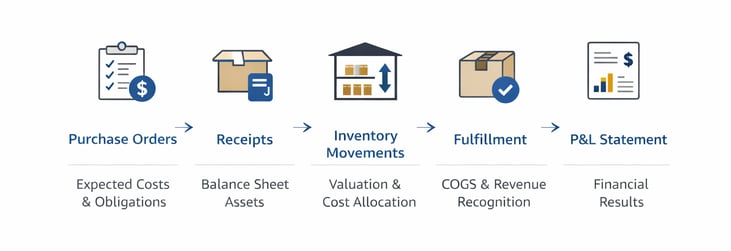
At a high level, the chain looks like this:
- Purchase orders establish expected cost and future obligations
- Receipts convert goods into balance sheet assets
- Inventory movements change valuation and cost allocation
- Fulfillment converts inventory into cost of goods sold
- The P&L aggregates the financial consequences of each event
Each step influences the next. Decisions made early in the chain shape the financial outcomes that eventually appear in the income statement.
1. The purchase order: Where financial reality begins
A purchase order establishes the quantities, expected unit costs, and payment terms for incoming inventory. Teams negotiate pricing, commit to production runs, and define delivery schedules with suppliers. At this stage the business is making commitments that will shape both inventory levels and future cash outflows.
Why it matters financially
The information captured in the purchase order determines the expected value of incoming inventory and establishes the company’s future financial obligations. Unit costs, quantities, and payment terms all contribute to how inventory will eventually be valued and how much capital will be tied up in working inventory.
Downstream impact
Purchase orders rarely stay static. Quantities change, shipments get split, vendors substitute components, and pricing adjustments happen during production. If those changes aren’t tracked consistently across systems, the expected cost basis for inventory starts to drift. That drift carries forward into landed cost calculations and eventually into margin reporting.
2. Receipt and landed cost: Turning goods into financial assets
Inventory arrives at a warehouse, fulfillment center, or production facility. Goods are inspected, counted, and entered into inventory records so they can be stored, assembled, or prepared for distribution.
Why it matters financially
At the moment of receipt, inventory becomes a balance sheet asset. But the unit cost recorded at this point rarely reflects the full cost of the product. Freight, duties, tariffs, insurance, and other fees have to be allocated to determine the true landed cost of each unit.
Downstream impact
Landed cost allocation isn’t always straightforward. Shipments may arrive in stages, invoices may appear weeks later, and freight costs may apply across multiple SKUs. When these costs are tracked manually or applied after the fact, unit costs become distorted. That distortion flows directly into inventory valuation and eventually into COGS calculations.
3. Inventory movements: Operational activity as financial events
Inventory rarely stays in one place. Products move between warehouses, get assembled into finished goods, or are adjusted to reflect damaged or missing stock. Transfers, production runs, and adjustments are routine parts of inventory operations.
Why it matters financially
Every movement changes the value and composition of the inventory asset. Transfers determine where inventory value sits across locations. Assemblies convert raw materials into finished goods with different cost structures. Adjustments change the total value recorded in inventory.
Downstream impact
Without a live inventory ledger connecting operational movements to financial value, discrepancies start to accumulate. Operational quantities may appear correct in warehouse systems while financial records tell a different story. Over time those differences require reconciliation to bring operational and financial records back into alignment.
4. Fulfillment and revenue: When inventory becomes COGS
Orders are fulfilled and products are shipped to customers through ecommerce channels, retail distribution, or wholesale agreements. Inventory leaves the warehouse and enters the customer’s hands.
Why it matters financially
Shipment converts inventory into cost of goods sold and triggers revenue recognition. At this point, the system has to determine the cost basis of the units being sold while also recording the associated revenue.
Downstream impact
If the underlying unit costs are incomplete or inaccurate, the resulting gross margin calculations won’t be reliable either. Discounts, platform fees, and returns add further complexity. Without accurate cost attribution, financial reports stop reflecting the true economics of each product sold.
5. The P&L: The result of dozens of micro events
By the time financial results are reported, inventory has moved through purchasing, receiving, storage, production, and fulfillment. Dozens of operational actions have shaped the final outcome.
Why it matters financially
COGS is the cumulative result of every cost allocation, inventory movement, and fulfillment event that occurred along the chain. Gross margin reflects the combined effects of purchasing discipline, landed cost accuracy, inventory management, and fulfillment execution.
Downstream impact
Errors introduced early in the chain compound as inventory moves through the system. By the time discrepancies appear in the P&L, the original source of the issue may be several operational steps removed. Period-end adjustments and reconciliations often end up correcting upstream inconsistencies rather than providing real financial insight.
A recent episode of the BlueOcean by StartOps podcast previewed the future of inventory management and automation
Understanding product-related costs
It’s easy to think of product cost as just the price you paid your supplier, but that’s only the beginning. The true cost of your inventory is much broader, covering all the expenses related to buying, storing, and managing your products from the moment you place an order. These inventory costs generally fall into three buckets: the cost of capital (the money tied up in stock that could be used elsewhere), handling costs (rent, labor, insurance), and risk costs (the chance that products get damaged, expire, or become obsolete). Holding too much inventory isn't just a space issue; it's a financial drain that can seriously impact your cash flow and lead to major losses if those items don't sell.
Accounting for inventory holding costs
Now let’s zoom in on inventory holding costs—all the expenses you rack up just to keep products on your shelves until they sell. These can be a silent killer for profit margins. Some costs are fixed, like your warehouse lease, but many are variable and climb as your inventory levels do. It's pretty shocking, but total inventory carrying costs can be as high as 25% of your inventory's value each year. This is exactly why precise, SKU-level visibility is non-negotiable. Without it, you’re flying blind, unable to see which products are costing you the most to hold. Cutting back on excess inventory isn't just about tidying up; it frees up warehouse space, reduces waste, improves your cash flow, and directly strengthens your bottom line.
Choosing the right inventory valuation method
Once you have a handle on your inventory's journey, you need to decide how to assign a dollar value to it. This isn't just an accounting exercise; the inventory valuation method you choose directly impacts your cost of goods sold (COGS), gross margin, and taxable income. The right method depends on your inventory type, business model, and how prices fluctuate in your industry. There are four main methods to consider, each with its own way of calculating the value of the inventory you've sold and what you still have on hand. Making a thoughtful choice here is crucial for accurate financial reporting and smart tax planning.
First-in, first-out (FIFO)
The First-In, First-Out (FIFO) method operates on a simple, logical assumption: the first inventory items you purchase are the first ones you sell. Think of it like a grocery store rotating its milk cartons—the oldest ones are moved to the front to be sold first. This approach is popular because it mirrors the actual physical flow of goods for many businesses, especially those dealing with perishable items. During periods of rising costs, FIFO results in a lower COGS because you're matching older, cheaper costs against current revenue. This leads to a higher reported gross profit and net income, which looks great to investors but also means a higher tax liability.
Last-in, first-out (LIFO)
Contrary to FIFO, the Last-In, First-Out (LIFO) method assumes that the most recently purchased inventory items are the first ones to be sold. This might seem counterintuitive for physical product flow, but it has significant financial implications, particularly for tax purposes. When costs are rising, LIFO matches the most recent, higher costs against revenue. This results in a higher COGS, which in turn lowers your reported profit and, consequently, your tax bill. While this can be a major advantage, it's important to note that LIFO is not permitted under International Financial Reporting Standards (IFRS), making it a less viable option for businesses with a global footprint.
Weighted average cost (WAC)
If tracking individual purchase costs feels too complex, the Weighted Average Cost (WAC) method offers a simpler alternative. This approach smooths out price fluctuations by calculating a single average cost for all your inventory items. You find this average by dividing the total cost of all goods available for sale by the total number of units. This average cost is then applied to both the items you've sold (COGS) and the items remaining in inventory. WAC is particularly useful for businesses that sell identical, high-volume products where it’s impractical to distinguish one unit from another. It provides a middle ground between FIFO and LIFO, avoiding extreme profit or loss figures during volatile price periods.
Specific identification method
The specific identification method is the most precise but also the most demanding. It involves tracking the exact cost of each individual item from purchase to sale. This method is only practical for businesses dealing with unique, high-value, and easily distinguishable products, such as custom jewelry, original artwork, or luxury cars. Because you're matching the specific cost of each item sold, it provides the most accurate possible gross margin for each sale. However, the detailed record-keeping required makes it unfeasible for most CPG brands or companies that handle large quantities of interchangeable SKUs. It requires a meticulous system to avoid confusion and ensure accuracy.
Key accounting rules for inventory valuation
Choosing a valuation method is just the first step. To maintain financial integrity and compliance, you also have to follow specific accounting rules. These principles, primarily governed by Generally Accepted Accounting Principles (GAAP) in the U.S., ensure that your financial statements are consistent, comparable, and present a true picture of your company's financial health. They prevent businesses from manipulating their inventory values to paint an overly optimistic or pessimistic picture. Adhering to these rules isn't just about staying out of trouble with auditors; it's about building a foundation of trust with investors, lenders, and other stakeholders who rely on your financial data to make decisions.
The lower of cost or market rule
The lower of cost or market (LCM) rule is a fundamental principle of conservative accounting. It dictates that if the market value of your inventory falls below what you originally paid for it, you must write down its value to that lower market price. This situation can happen due to obsolescence, damage, or a general decline in demand. By recording this loss, you ensure that your balance sheet doesn't overstate the value of your assets. This practice gives a more realistic view of your company's financial position and prevents you from carrying inventory at a value you can no longer recover through a sale.
International standards and the LIFO ban
If your business operates or plans to expand internationally, you need to be aware of the differences between U.S. GAAP and International Financial Reporting Standards (IFRS). One of the most significant distinctions relates to inventory valuation. While GAAP allows for the use of FIFO, WAC, and LIFO, IFRS explicitly prohibits the LIFO method. The reasoning is that LIFO often doesn't reflect the true physical flow of goods and can distort earnings. For companies that need to report under both standards, this means maintaining separate records or forgoing the potential tax benefits of LIFO to ensure global compliance and consistency in financial reporting.
Restrictions on changing methods
Consistency is key in accounting. Once you select an inventory valuation method, you can't simply switch to another one to get a more favorable financial result in a given year. The IRS requires that you stick with your chosen method for tax purposes to ensure comparability from one period to the next. If you have a legitimate business reason to change methods (for example, a significant change in your product line or operations), you must formally apply for permission from the IRS. This rule prevents companies from cherry-picking methods to artificially lower their tax burden and ensures that financial statements remain a reliable measure of performance over time.
Common challenges in inventory valuation
In theory, inventory valuation seems straightforward. In practice, it’s where the clean lines of accounting meet the messy reality of operations. The journey from purchase order to profit and loss statement is filled with potential pitfalls. Every manual entry, system handoff, and physical movement creates an opportunity for error. These small discrepancies can compound over time, leading to inaccurate financial reports and poor business decisions. Overcoming these challenges requires more than just a good accountant; it requires systems and processes that connect your operational activities directly to their financial consequences in real time.
Tracking large volumes of stock
For any growing CPG brand, managing thousands of SKUs is a monumental task. Manually tracking each item's cost, quantity, and location is not just inefficient—it's a recipe for disaster. Spreadsheets can quickly become outdated and riddled with errors, leading to incorrect inventory counts and flawed valuations. Without a robust inventory management system, it's nearly impossible to maintain the accuracy needed for reliable financial reporting. This lack of visibility can result in stockouts of popular items, overstocking of slow-movers, and a distorted understanding of your true profitability at the SKU level.
Managing multiple locations
The complexity of inventory valuation multiplies with each new storage location. Whether you're using multiple warehouses, third-party logistics (3PL) providers, or retail storefronts, keeping a unified and accurate view of your stock becomes incredibly difficult. Each location may use different systems or processes, creating data silos that are difficult to reconcile. Transferring goods between locations adds another layer of complexity, as you have to track the inventory's value as it moves. Without a centralized system that provides a single source of truth, you risk making decisions based on fragmented and incomplete data.
Auditing and reconciliation discrepancies
Discrepancies between your physical inventory counts and your financial records are a common but serious problem. These gaps often stem from errors that occurred much earlier in the supply chain—a miskeyed PO, an inaccurate landed cost allocation, or an untracked inventory movement. By the time these issues surface during a month-end close or an audit, tracing them back to the source is a time-consuming and frustrating process. An AI-native ERP like Mandrel is built to solve this by creating an end-to-end, transaction-level audit trail. By centering finance and operations around the SKU, it ensures that every operational event is automatically translated into an accurate financial record, eliminating the need for painful reconciliations.
How to get your inventory valuation cost right
The traditional systems that most inventory-driven businesses rely on are inherently vulnerable to “losing the plot”, financially speaking.
Purchasing systems track orders. Warehouse systems track quantities. Accounting systems summarize financial activity. Each system captures a piece of the picture, but none of them reflects the full sequence of operational events that ultimately determines inventory value and cost of goods sold.
That gap creates constant friction. The numbers that matter most are often the hardest to explain. Finance teams spend days reconciling systems just to understand what actually happened. And decisions about pricing, purchasing, and inventory levels end up relying on approximations, not clear data.
A better approach is to design systems around the flow itself. In a well-designed system:
- Purchase orders connect directly to receipts and supplier invoices
- Freight, duties, and other costs are allocated automatically at the SKU level
- Inventory movements update valuation as they happen
- Fulfillment events trigger both revenue recognition and cost of goods sold
Instead of summarizing inventory activity after the fact, the system reflects the financial consequences of each operational event directly.
That’s the idea behind Mandrel.
Inventory accounting doesn’t begin in the general ledger. It begins the moment a purchase order is issued. Mandrel connects purchasing, inventory, fulfillment, and accounting at the SKU level so the financial consequences of operational events are captured automatically from purchase order to P&L.
If you’d like to see how this approach works in practice, you can schedule a demo with one of our inventory management experts.
Use valuation for better forecasting and planning
When you have a clear, real-time picture of your inventory's value, you can stop guessing and start planning with confidence. Accurate valuation isn't just a backward-looking accounting exercise; it's the foundation for smart financial forecasting. Knowing the true cost tied up in your goods helps you project future cash flow, prepare for tax obligations, and understand your profitability on a granular level. This data transforms your inventory from a simple list of products into a strategic asset, giving you the insights needed to make informed decisions about purchasing, pricing, and growth.
Reduce risk with accurate inventory data
Uncertainty is the enemy of a healthy supply chain. Good inventory management, built on precise valuation, is one of your best defenses against business risk. When you know exactly what you have and what it's worth, you can sidestep the two most common inventory traps: tying up too much capital in slow-moving products or losing sales because of unexpected stockouts. This clarity directly improves your cash flow, ensuring money is working for your business instead of sitting on a warehouse shelf. It creates a more resilient operation that can adapt to market changes without compromising financial stability.
Apply optimization techniques
Once you have reliable, real-time inventory data, you can shift from reactive problem-solving to proactive optimization. Instead of just correcting errors after the fact, you can start using proven techniques to make your inventory work harder for you. This is where the right systems make all the difference. When your operational events—like receiving a shipment or fulfilling an order—are instantly reflected as financial transactions, you have the live data needed to apply powerful optimization strategies. This approach allows you to fine-tune your inventory levels, reduce costs, and improve efficiency across the board.
ABC analysis
Think of ABC analysis as applying the 80/20 rule to your stock. This method involves categorizing your inventory based on its value and sales frequency to prioritize your management efforts. Your "A" items are the stars—high-value products that make up the bulk of your revenue and require close monitoring. "B" items are moderately important, while "C" items are your low-value, slow-moving products that need less attention. By using ABC analysis, you can focus your time and capital on the SKUs that matter most to your bottom line.
Safety stock
Safety stock is the buffer inventory you hold to protect against unexpected events, like a sudden surge in demand or a delay from your supplier. The goal is to find the perfect balance: enough extra stock to prevent costly stockouts, but not so much that you’re tying up unnecessary cash in holding costs. Calculating the optimal safety stock level requires accurate data on lead times and demand variability. With the right information, you can ensure you have a reliable cushion that keeps customers happy without draining your financial resources.
Economic order quantity (EOQ)
The Economic Order Quantity (EOQ) formula helps you determine the ideal amount of inventory to order at one time. It’s all about minimizing the total costs associated with purchasing and holding stock. If you order too little, you’ll face frequent ordering costs and risk stockouts. If you order too much, your holding costs will climb. EOQ identifies the sweet spot that keeps both of these costs at a minimum, helping you manage inventory more efficiently and cost-effectively. It’s a simple but powerful tool for streamlining your purchasing process.
Related articles
- Spreadsheets, IMS, or ERP? The Architecture Question Most Brands Miss
- SKU-Level Economics: What Your Gross Margin Isn’t Telling You
- Landed Costs: Not Just Another Financial Metric
- Turn POs into Profits: Strategies for Optimizing Purchase Orders
- Navigating The Impact of Tariffs on Margins
Frequently asked questions
Why is my gross margin not a reliable indicator of profitability? Your overall gross margin is an average, and averages can hide a lot. It blends the performance of all your products together, so you can't see which specific SKUs are your true winners and which are quietly losing you money. A product might look profitable on paper, but once you factor in its unique landed costs, high storage expenses, or frequent returns, the story can change completely. True profitability is found at the SKU level, not in a blended, top-line number.
What costs should I include in my inventory valuation besides the supplier's price? To get an accurate picture, you need to look beyond the purchase price and calculate a "fully-loaded" cost for each unit. This includes all the landed costs required to get the product to your warehouse, such as freight, tariffs, duties, and insurance. You should also consider the inventory holding costs, which are the expenses you incur just by having products on your shelves. These include warehouse rent, labor, and the cost of the capital tied up in unsold stock.
How do I choose the right inventory valuation method for my business? The best method really depends on the kind of products you sell and how your costs fluctuate. FIFO is often a good fit for businesses with perishable goods because it mirrors the natural flow of selling older stock first. LIFO can provide tax benefits when costs are rising, but it's not permitted under international accounting standards. The weighted average cost method is a simpler choice that smooths out price changes, making it useful for companies selling large volumes of identical items.
Why do my inventory records never seem to match between my warehouse and finance teams? This is a classic problem that comes from using separate systems that don't communicate in real time. Your warehouse team records a physical movement, but that action isn't instantly translated into a financial event in your accounting software. Small changes like a split shipment, a PO price update, or a stock transfer create tiny gaps between operational reality and the financial records. Over a month, these small gaps add up to a major reconciliation headache.
Can I switch my inventory valuation method whenever I want? No, you can't easily switch back and forth. Consistency is a core accounting principle, and both GAAP and the IRS require you to stick with your chosen method from one period to the next. This ensures your financial statements are comparable over time. If you have a strong business reason for making a change, you must go through a formal process, which often involves getting approval from the IRS to ensure it's not just to manipulate your tax liability.
Key Takeaways
- Choose your valuation method wisely: The method you select, whether it's FIFO, LIFO, or weighted average, is a strategic decision that directly shapes your Cost of Goods Sold, reported profits, and tax obligations.
- Every operational step is a financial event: A product's true cost accumulates throughout its entire journey, from purchase order to final sale. If you don't track the financial impact of each step, small errors will grow into significant discrepancies on your P&L.
- Connect your systems for a clear picture: Accurate inventory valuation depends on a single source of truth that links your warehouse operations to your financial records in real time, giving you the clarity needed for smart forecasting and planning.

.png)