At a certain point, every growing CPG brand hits a wall with spreadsheets. What once worked for tracking a handful of SKUs becomes a liability, prone to errors that can cost you real money in lost sales or excess stock. Graduating to a dedicated system is one of the most important steps you can take to scale effectively. But with so many options, where do you even begin? We’ve done the research for you, breaking down the best inventory management solutions available for physical goods businesses. We’ll cover everything from key features and pricing to what you can expect during implementation, giving you a clear roadmap to find the perfect operational partner for your brand.
Key takeaways
- Focus on solving your biggest operational headaches: The best inventory software does more than track units; it eliminates costly errors from manual data entry, prevents stockouts that lose sales, and gives you an accurate financial picture.
- Demand SKU-level financial clarity: Your inventory system should connect directly to your finances, automating complex calculations like landed costs and COGS to give you a true, real-time understanding of each product's profitability.
- Select a system that can grow with you: Before you commit, map out your integration needs and future expansion plans. The right choice is a scalable platform that fits your current tech stack and prevents a painful migration process in a few years.
The top inventory management solutions
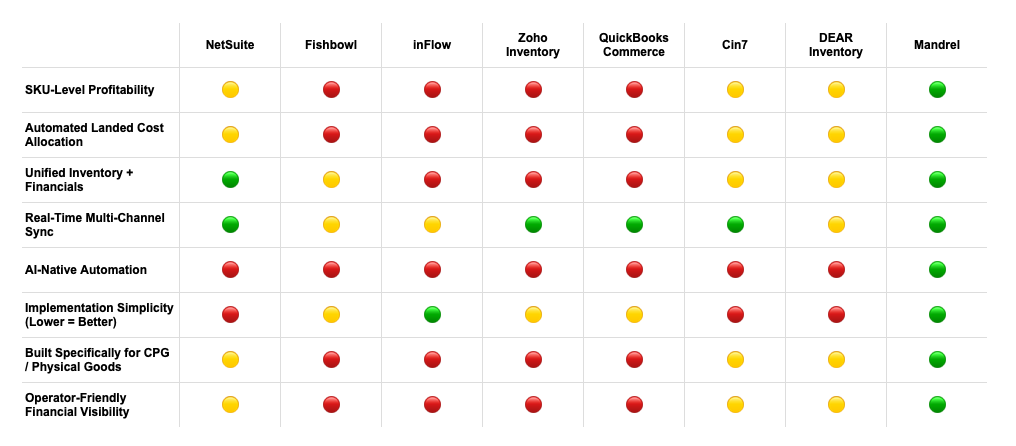
Choosing the right inventory management software can feel like a huge decision—because it is. The right tool can streamline your operations, prevent stockouts, and give you a clear picture of your financial health. The wrong one can create data silos and manual work headaches that hold your business back. To help you find the perfect fit, we’ve put together a list of eight top-tier solutions that are popular with CPG brands.
Each of these platforms offers a unique set of features tailored to different business sizes and needs. Whether you're a growing startup looking for an intuitive system or an established brand needing a powerful, all-in-one ERP, there’s something here for you. We’ll walk through what makes each one stand out, who it’s best for, and what you can expect from its core functionality. This isn't just a feature list; it's a guide to help you match a solution to your specific challenges, like managing multiple sales channels or getting accurate landed costs. Think of this as your starting point for finding a system that will not only manage your inventory but also help your business grow.
1. Mandrel: AI-native ERP for physical goods
If you’re a CPG brand that wants to build your business around accurate, real-time data, Mandrel is designed for you. It’s an AI-native ERP built specifically for companies that sell physical products. Instead of just tracking inventory, Mandrel centers your entire operations and finance workflows around your SKUs. This means you get incredible visibility into your revenue, costs, and inventory availability on a per-unit basis. It automates tedious tasks like landed cost allocation and revenue recognition, giving you a clear, auditable financial picture without the manual spreadsheet work. It’s a modern solution for brands that need precision and efficiency to scale.
2. NetSuite Inventory Management
NetSuite is a well-known name in the ERP world, offering a powerful and comprehensive inventory management system. It’s often a fit for established CPG brands that operate across multiple locations or require deep customization. NetSuite allows you to track inventory from procurement to delivery, manage orders, and connect inventory with financials and CRM data.
However, that power comes with tradeoffs. NetSuite implementations can be lengthy and resource-intensive, often requiring third-party consultants and ongoing administrative oversight. Many growing brands find themselves paying for broad ERP functionality they do not fully use. For teams primarily focused on SKU-level profitability, cash flow clarity, and operational speed, the complexity can outweigh the benefits.
3. Fishbowl Inventory
Fishbowl is a popular option for small and mid-sized businesses, especially those running on QuickBooks. It offers core inventory features such as real-time tracking, order management, and barcoding without requiring a full ERP deployment.
Its biggest limitation is architectural. Fishbowl operates as an add-on rather than a fully unified financial and operational system. Inventory and accounting remain connected but separate, which can still require reconciliation and manual oversight. As brands grow in complexity, many outgrow Fishbowl’s capabilities and need to migrate again to gain deeper SKU-level financial visibility.
4. inFlow Inventory
inFlow is built for simplicity. It’s intuitive, easy to adopt, and well-suited for small teams that need basic inventory tracking and order management.
That simplicity is also its ceiling. Advanced capabilities like automated landed cost allocation, multi-entity financial visibility, or deeper SKU profitability analysis are limited. For fast-growing CPG brands that need more than stock counts and purchase orders, inFlow can become restrictive as operational complexity increases.
5. Zoho Inventory
Zoho Inventory is a cloud-based solution designed to sync stock levels across ecommerce platforms such as Shopify, Amazon, and Etsy. It’s a strong fit for brands already invested in the Zoho ecosystem.
The challenge lies in fragmentation. Zoho Inventory works best when paired with other Zoho apps, but many brands use mixed technology stacks. Integrating financials, purchasing, and operational workflows outside the Zoho environment can introduce additional connectors and manual oversight. For brands seeking tightly unified inventory and financial data in a single operational system, this layered approach can create friction.
6. QuickBooks Commerce (formerly TradeGecko)
QuickBooks Commerce is designed for modern ecommerce brands and wholesalers. It centralizes orders, customers, and inventory in a relatively streamlined interface.
However, it is not a full ERP. While it improves visibility across sales channels, deeper financial automation, SKU-level margin analysis, and complex landed cost workflows often require external processes or accounting workarounds. For brands prioritizing financial precision alongside operational control, it may not provide the depth needed as they scale.
7. Cin7
Cin7 is positioned as an all-in-one automation platform connecting sales channels, inventory, and supply chain operations. It’s particularly useful for businesses with multi-channel retail strategies.
That breadth can also introduce complexity. Many users report steep learning curves and reliance on configuration to make workflows match real-world operations. Additionally, while Cin7 centralizes data, advanced financial automation and clean SKU-level profitability reporting may still require external accounting systems or layered reporting tools.
8. DEAR inventory (now part of Cin7)
DEAR Inventory, now under the Cin7 umbrella, offers strong functionality for manufacturing and wholesale operations, including batch tracking and expiry management.
As part of a larger acquisition ecosystem, product direction and support structures have evolved. Some brands find the transition and platform consolidation adds uncertainty. Additionally, like many inventory-first tools, deeper financial automation and SKU-level margin clarity may require significant integration work with external accounting systems.
Key features for an inventory management solution
Choosing an inventory solution isn't just about tracking what’s on the shelf; it's about finding a central nervous system for your entire operation. For CPG brands, the stakes are high—you're dealing with expiration dates, complex supply chains, and fluctuating consumer demand. The right software doesn't just count boxes; it provides the intelligence you need to grow profitably. As you evaluate your options, focus on platforms that offer a specific set of features designed to handle the unique challenges of physical goods. These are the non-negotiables that separate a basic tool from a true operational partner.
✓ Real-time SKU-Level visibility
You can't manage what you can't see. Real-time, SKU-level visibility means knowing exactly what you have, where it is, and what it's worth at any given moment. This level of detail is crucial for preventing stockouts on your bestsellers or getting stuck with excess inventory of a slow-moving product. When you have an accurate, live view of your stock, you can make smarter purchasing decisions and run promotions with confidence. It’s the foundation for maintaining optimal inventory levels and ensuring you can always meet customer demand without tying up unnecessary cash in your warehouse.
✓ Automated workflows and document processing
The amount of manual data entry involved in running a CPG brand can be staggering. From processing purchase orders and invoices to allocating landed costs, these tasks are not only time-consuming but also prone to human error. A modern inventory solution should automate these workflows. Look for systems that can automatically ingest documents, match them to transactions, and handle complex calculations without manual intervention. This frees up your team to focus on strategic growth instead of tedious paperwork. Streamlining your operations with automation leads to greater efficiency, fewer mistakes, and a much clearer picture of your costs and margins.
✓ Demand forecasting and analytics
Guesswork is expensive. Effective demand forecasting helps you anticipate what your customers will want to buy, allowing you to stock the right products at the right time. The best inventory management tools use data analytics and even AI to analyze historical sales data, seasonality, and market trends to generate reliable forecasts. This is essential for minimizing carrying costs and avoiding the lost revenue that comes from stockouts. Instead of reacting to the market, you can proactively manage your inventory, plan production runs, and ensure your products are always available when your customers are ready to buy.
✓ Multi-channel integration
Today, your customers are everywhere—on your website, on Amazon, in retail stores—and your inventory system needs to be, too. A solution with strong multi-channel integration capabilities is a must. It should seamlessly connect with your various sales channels, syncing inventory levels in real time across all platforms. This prevents you from accidentally selling an out-of-stock item on one channel because the sale on another channel hadn't registered yet. Managing inventory across multiple platforms efficiently eliminates manual reconciliation, improves the customer experience, and gives you a single, unified view of your sales and stock.
✓ Financial reporting and compliance
Your inventory is one of your biggest assets, and how you manage it has a direct impact on your financial health. An inventory solution should be deeply integrated with your accounting processes. It needs to provide accurate data for critical financial reports, including your balance sheet and cost of goods sold (COGS). For growing brands, ensuring this data is GAAP-compliant and auditable is essential for securing funding or planning an exit. A system that provides transaction-level accuracy gives you reliable financial reporting, which is critical for managing cash flow. You can book a demo to see how an AI-native ERP can ensure end-to-end auditability.
✓ Barcode and serial number tracking
Accuracy in the warehouse is everything. Implementing barcode and serial number tracking streamlines your entire fulfillment process, from receiving new stock to picking, packing, and shipping orders. Scanning items reduces manual errors to almost zero, ensuring your inventory records are always precise. For many CPG brands, especially in food, beverage, or supplements, this level of tracking is also vital for traceability. In the event of a product recall, you can quickly identify and locate affected batches, protecting both your customers and your brand's reputation. It’s a fundamental feature for maintaining control and efficiency in your physical operations.
Breaking down the costs: Pricing & scalability
The price tag on an inventory management solution is just one piece of the puzzle. What you’re really looking for is a system that fits your budget today and can grow with you tomorrow. The cost structure often reflects the complexity and scale of the businesses they serve, from enterprise-level powerhouses to nimble startups. Let's break down what you can expect at each stage and what truly drives the long-term cost.
Enterprise-level solutions
For large CPG brands, inventory management is the backbone of the operation. These systems come with a hefty price tag, often involving custom quotes, implementation fees, and ongoing support contracts. But for a business managing thousands of SKUs across multiple warehouses, the cost is justified. A powerful CPG ERP system helps you track inventory levels with precision, preventing costly overstocking and missed sales from stockouts. At this scale, inventory management is central to every critical business function, from finance to fulfillment. The investment protects your margins and ensures your supply chain runs smoothly, no matter how complex it gets.
Mid-market options
If your brand is growing fast, you’re likely in the mid-market category. You need more than a basic spreadsheet but aren't ready for a full-blown enterprise system. Mid-market solutions offer a sweet spot, providing robust features without the enterprise-level price. These platforms are designed to handle the complexities of a growing CPG brand, like managing different types of inventory from raw materials to finished goods. Pricing is often tiered based on order volume, users, or features, allowing you to pay for what you need. The key here is scalability—the right solution will support your growth, not hold you back.
Small business and free tiers
When you're just starting out, every dollar counts. Many inventory management tools offer free or low-cost tiers designed for small businesses. These are perfect for brands graduating from spreadsheets. Manually tracking things like cost of goods sold (COGS) and landed costs quickly becomes a headache as you scale, and these tools bring much-needed automation. While free tiers have limitations—like caps on SKUs or orders—they provide a solid foundation. They let you establish good inventory habits early on, so you’re ready to move to a paid plan once your sales take off.
What really affects Long-Term costs?
The initial price of an inventory solution is only part of the story. The real financial impact comes from its long-term value. An effective system does more than just track stock; it directly contributes to your bottom line by ensuring products are available when customers want them, which increases sales and cuts losses from stockouts. Features like demand forecasting and automated tracking help keep operational costs in check. When evaluating options, think about the total cost of ownership, including implementation, training, and support. The right system isn't an expense—it's an investment in efficiency and profitability.
The inventory problems these tools can fix
Investing in an inventory management solution isn't just about getting a better handle on your stock counts. It's about solving the fundamental, often costly, problems that hold back growing CPG brands. From frustrating stockouts to messy spreadsheets and inaccurate financial reports, the right software brings clarity and control to your operations. These tools are designed to tackle the specific challenges that come with managing physical products, turning operational headaches into opportunities for growth and efficiency. Let's look at the most common issues these platforms are built to solve.
X Stockouts and overstocking
Finding the sweet spot between having too much inventory and not enough is a constant challenge. Stockouts lead to lost sales and unhappy customers, while overstocking ties up your cash in products that aren't selling, increasing storage costs and the risk of obsolescence. Effective inventory management ensures that your products are available when customers need them, preventing both stockouts and overstocking. By tracking sales velocity and setting automated reorder points, these systems help you maintain optimal stock levels, protecting your revenue and your margins. This balance is crucial for managing your inventory carrying costs and keeping your cash flow healthy.
X Manual data entry errors
If you’re still relying on spreadsheets to track inventory, you know how easy it is for one typo to throw everything off. Manual data entry is not only time-consuming but also incredibly prone to human error. A single misplaced decimal or incorrect SKU can lead to inaccurate inventory records, causing you to order the wrong products or misinform customers about availability. Automated inventory tracking helps eliminate these costly mistakes. By using tools like barcode scanners and system integrations, you can reduce human errors and ensure your data is consistently accurate, giving you a reliable foundation for every business decision.
X Inaccurate demand forecasting
Guessing how much product you'll need next quarter based on last year's sales is a recipe for trouble. Consumer trends shift quickly, and seasonality can have a huge impact on demand. Without solid data, you're essentially flying blind. Modern inventory solutions use data analytics and sales history to create a much more accurate demand forecast. They analyze patterns and trends to help you anticipate customer needs, allowing you to stock up before a busy season or pull back on a slow-moving item. This data-driven approach is essential for maintaining the right amount of inventory and planning your production schedules effectively.
X Lack of real-time visibility
How long does it take you to find out exactly how many units of a specific SKU you have across all your locations? If the answer isn't "instantly," you have a visibility problem. Without a live view of your inventory, you can't make quick, informed decisions. Real-time tracking is a core feature of any good inventory solution, giving you an up-to-the-minute picture of stock levels. This is especially critical for CPG brands that need to respond quickly to sales spikes or supply chain disruptions. With platforms like Mandrel, you get real-time, SKU-level visibility into your inventory, costs, and revenue, all in one place.
X Complex financial reporting
Your inventory is one of your biggest assets, and how you track it has a direct impact on your financial statements. Manually calculating the cost of goods sold (COGS), performing inventory valuation, and closing the books each month can be a complex and error-prone process. An inventory management system simplifies financial reporting by automating these calculations. It provides accurate, auditable data on inventory value and COGS, ensuring your P&L is correct and your business is GAAP-compliant. This automation saves your finance team countless hours and gives you confidence in your numbers.
X Multi-Location management
As your brand grows, so does your operational footprint. Managing inventory across your own warehouse, a 3PL partner, and maybe even a few retail locations can quickly become a logistical nightmare. Without a central system, you risk having conflicting data and no single source of truth. Inventory management tools are designed to solve this by providing centralized control over your entire stock. You can track inventory movements between locations, manage transfers, and view consolidated stock levels from a single dashboard. This unified view is essential for scaling your operations efficiently and maintaining control as your business expands.
A recent podcast discussing going deep into future of ERP
Is an inventory management solution right for your industry?
While every business selling physical products needs to track inventory, the right solution looks different depending on your industry. The challenges of selling fast-fashion apparel are worlds apart from managing perishable food items or assembling complex electronics. Understanding the specific demands of your sector is the first step toward finding a system that truly supports your operations instead of just complicating them.
Think of it less as a one-size-fits-all tool and more as a specialized partner for your business. The right inventory management software addresses your industry’s unique pain points, from regulatory compliance and expiration dates to multi-channel sales and raw material tracking. Let’s look at what that means for some key industries.
Consumer packaged goods (CPG)
For CPG brands, inventory management is the backbone of the entire business. The market is defined by high volume, relatively low margins, and the constant pressure of promotions and seasonal demand. Effective inventory management can genuinely make or break a brand’s competitiveness. You’re not just tracking boxes; you’re managing expiration dates, bundling products for promotions, and ensuring your bestsellers are always on the shelf. A solid inventory system provides the visibility needed to prevent stockouts during a key sales period and avoid getting stuck with expired products, making it central to your most business-critical operations.
Manufacturing
If you’re a manufacturer, your inventory isn’t just one category—it’s a flow. You have raw materials coming in, works-in-progress on the assembly line, and finished goods going out. A simple spreadsheet can’t keep up with that complexity. The right inventory system helps you track supplies at every stage to avoid the costly pitfalls of overstocking or understocking. By accurately forecasting demand, you can optimize production schedules, ensure you have the right components on hand without tying up cash in excess materials, and keep the entire operation running smoothly. This level of control is key to mastering consumer goods inventory management.
E-commerce and retail
In e-commerce and retail, your inventory is your promise to the customer. Today’s shoppers expect to see accurate stock levels across every channel, whether they’re browsing your website, scrolling through Amazon, or visiting your physical store. This requires a system that can handle multiple sales channels and sync data in real time. Without a single source of truth, you risk overselling a popular item and having to cancel orders, which is a quick way to lose customer trust. A robust inventory solution prevents these issues, ensuring product availability and a seamless experience for your customers, no matter where they shop.
Food and beverage
For food and beverage companies, inventory management goes beyond profit margins—it’s about safety and compliance. Managing perishable goods means you’re in a constant race against the clock. An inventory system built for this industry is critical for tracking expiration dates with precision, ensuring product freshness, and adhering to strict safety regulations. Features like batch and lot tracking are non-negotiable, as they allow you to quickly trace products in the event of a recall. This isn't just good business; it's an essential practice for protecting your customers and your brand’s reputation in an industry where inventory management for CPG brands has the highest stakes.
How to choose the right solution for your business
With so many options on the market, picking the right inventory management software can feel overwhelming. The best choice for your business depends entirely on your specific needs, budget, and growth plans. Instead of getting distracted by flashy features, focus on a system that solves your most pressing problems and can grow with you. A methodical approach will help you cut through the noise and find a solution that truly fits your brand.
Let’s walk through the four key steps to evaluating and choosing the right inventory management partner for your business.
Step 1: Assess your current pain points
Before you can find the right solution, you need a crystal-clear picture of the problem. Effective inventory management is central to so many of a CPG brand’s critical operations, so small issues can quickly ripple into major headaches. Get your team together—from operations to finance—and make a list of your biggest challenges. Are you constantly dealing with stockouts of your best-sellers? Is manual data entry leading to costly errors? Are you struggling to get an accurate picture of your landed costs and profit margins for each SKU? Pinpointing these specific pain points will give you a concrete checklist to measure potential solutions against.
Step 2: Define your integration needs
Your inventory management system won't operate in a silo. It needs to communicate seamlessly with the other tools you rely on every day. Map out your current tech stack. Which platforms are non-negotiable? This could include your ecommerce storefronts like Shopify or Amazon, your accounting software, and your third-party logistics (3PL) provider. As CPG brands grow, they use data analytics to forecast demand and automated tracking to keep stock levels optimal. A solution with robust, pre-built integrations will help you streamline operations from day one, creating a single source of truth for your business data and preventing manual workarounds.
Step 3: Evaluate how you plan to scale
The software that works for you today might not be the one that supports you tomorrow. Think about where your business is headed in the next three to five years. Are you planning to launch new product lines, expand into wholesale, or add more sales channels? As you grow, you’ll need to manage inventory levels effectively to ensure product availability while minimizing excess stock. Choose a platform that can handle increased complexity, whether that’s managing multiple warehouses, processing higher order volumes, or providing more advanced financial reporting. A scalable solution prevents you from having to go through a painful migration process down the road.
Step 4: Calculate the total cost of ownership
The sticker price is just one piece of the puzzle. To understand the true investment, you need to calculate the total cost of ownership. Look beyond the monthly subscription fee and ask about implementation costs, data migration support, training fees, and charges for premium customer service. At the same time, consider the cost of inaction. A good system helps you track inventory so you don't experience overstocking or understocking, which directly impacts cash flow and operational efficiency. The right platform might have a higher upfront cost but could save you thousands in the long run by preventing stockouts and improving margins. Booking a demo is a great way to get a clear, all-in cost estimate.
What to expect during implementation
Switching to a new inventory management system is a big move, but it doesn’t have to be a painful one. The key is knowing what’s coming and planning for it. A successful rollout isn’t just about the software—it’s about the process you follow to get it up and running. A structured implementation plan ensures you start seeing a return on your investment as quickly as possible by minimizing disruption and avoiding common pitfalls like missed deadlines or low team adoption. Think of it as a project with a clear beginning, middle, and end, where each phase builds on the last. By breaking it down into manageable steps, you can make the transition smooth and set your business up for more efficient, scalable operations from day one.
The planning and setup phase
Before you move a single piece of data, you need a solid plan. This initial phase is all about defining what success looks like for your company. Start by mapping your current inventory workflows—from receiving to fulfillment—and pinpointing the exact bottlenecks you want the new system to solve. Effective inventory management is crucial for CPG brands, and a robust planning phase ensures all your unique operational needs are covered. This is the time to set clear goals, assign a project lead, and get key stakeholders from different departments, like finance and operations, involved to make sure everyone’s requirements are heard and accounted for.
Handling your data migration
Moving your historical data into a new system is one of the most critical parts of the implementation. This process, known as data migration, involves transferring everything from SKU details and supplier information to sales history and cost data. It needs to be planned meticulously to avoid errors or data loss, because the accuracy of your new system depends entirely on the quality of the data you put into it. Before you start, take the time to clean up your existing data—fix inconsistencies, remove duplicates, and fill in any missing information. A clean dataset is the foundation for accurate reporting and forecasting in your new system.
Getting your team onboard
A new tool is only as good as the team using it. Getting your people comfortable and confident with the new system is essential for a successful launch. This goes beyond a single training session; it’s about communicating the benefits early and often, explaining how the software will streamline daily tasks and reduce manual work. Schedule hands-on training tailored to different roles, whether it’s the warehouse team or the finance department. Appointing a few tech-savvy "champions" on your team can also create internal experts who can help their colleagues and build momentum for adoption across the company.
Setting a realistic timeline
A smooth transition depends on a realistic timeline. Rushing the process is a recipe for stress and mistakes that can cause disruptions down the line. When you map out your schedule, consider all the moving parts: the complexity of your operations, the amount of data you need to migrate, and your team’s availability for training. Work with your software provider to understand their typical implementation timeline and build in a buffer for unexpected delays. A well-paced rollout allows for proper testing and ensures everyone is ready to hit the ground running on day one without disrupting your business operations.
The best inventory management solution isn't a one-size-fits-all product. The right choice depends entirely on your business model, your industry's specific demands, and where you plan to grow.
Finding the right fit for your business
The best inventory management solution isn't a one-size-fits-all product. The right choice depends entirely on your business model, your industry's specific demands, and where you plan to grow. A brand that manufactures its own products has different needs than a multi-channel retailer, and a small but growing business requires a different toolset than an established enterprise. Let's break down what different types of businesses should look for to find the perfect fit.
For CPG and physical goods companies
If you’re in the CPG space, you know that inventory is everything. It’s not just about finished products on a shelf; you’re likely managing raw materials, work-in-progress (WIP) goods, and even supplies for maintenance and operations. Effective inventory management is central to your business-critical operations, influencing everything from production planning to cash flow. You need a system that can handle this complexity, providing clear visibility across all inventory types. The goal is to ensure you have the right materials for production runs while preventing finished goods from expiring or becoming obsolete.
For multi-channel retailers
Selling across your own website, wholesale accounts, and multiple online marketplaces creates a complex web of inventory. The biggest challenge for multi-channel retailers is maintaining a single source of truth for stock levels. Without it, you risk overselling products and disappointing customers. A strong inventory solution provides real-time visibility across all your sales channels, automatically updating stock counts as orders come in. This allows you to prevent stockouts, make smarter purchasing decisions, and streamline order fulfillment no matter where the sale happens.
For manufacturing businesses
For manufacturers, inventory management is deeply tied to production efficiency. It’s not just about tracking what you have, but ensuring you have the right components at the right time to keep production lines moving. Running out of a single raw material can bring everything to a halt, while overstocking ties up capital that could be used elsewhere. A system designed for manufacturing helps you track supplies, optimize production schedules, and manage your supply chain logistics more effectively. This ensures a smoother process from raw material procurement to finished product.
For small to medium-sized businesses
If you’re a small or medium-sized business, you’ve probably experienced the limits of spreadsheets. While they work for a while, manually tracking cost of goods sold (COGS), landed costs, and inventory valuation quickly becomes a source of errors and wasted time as you scale. Investing in a dedicated inventory solution is a crucial step for growth. It automates these tedious tasks, reduces the risk of human error, and provides the accurate financial data you need to make informed decisions. This move helps you operate more efficiently and build a solid foundation for future expansion.
Related articles
- Inventory Management System for Small Business: 2026 Guide
- Landed Costs: Not Just Another Financial Metric
- Turn POs into Profits: Strategies for Optimizing Purchase Orders
- Navigating The Impact of Tariffs on Margins
Frequently asked questions
When is the right time to switch from spreadsheets to a dedicated inventory system?
The tipping point is usually when your current process starts costing you more than it saves. If you're spending hours manually reconciling numbers, consistently overselling popular products, or can't get a clear picture of your profitability per SKU, it's time. It’s less about hitting a specific revenue milestone and more about recognizing when manual errors and operational blind spots are holding your business back from growing efficiently.
What’s the real difference between an inventory management tool and a full ERP?
Think of it as the difference between a specialized tool and a complete toolkit. An inventory management system is laser-focused on tracking stock, managing orders, and handling warehouse operations. An ERP, or Enterprise Resource Planning system, integrates inventory into the core of your entire business. It connects your stock data directly to your financials, operations, and sales, creating a single source of truth for everything from landed costs to revenue recognition.
How do I know which features are most important for my business right now?
Start by identifying your single biggest operational headache. If you sell on Shopify, Amazon, and through wholesale, then multi-channel integration is your non-negotiable. If you sell food or cosmetics, then batch and expiry date tracking is your top priority. Don't get distracted by a long list of features you might use someday. Focus on the tools that will solve your most expensive and time-consuming problems first.
My business uses a 3PL. how does that work with these systems?
Most modern inventory platforms are designed to connect seamlessly with third-party logistics (3PL) providers. The software acts as the central command center, syncing inventory data between your sales channels and your 3PL’s warehouse system. This ensures that when you make a sale, the order is automatically sent to your partner for fulfillment, and stock levels are updated everywhere in real time. It eliminates the need for manual order entry and keeps everyone on the same page.
How much should I really expect to spend on an inventory management system?
The cost varies widely, from free plans for startups to significant investments for enterprise-level systems. Instead of focusing only on the monthly fee, consider the total value. A good system should pay for itself by preventing costly stockouts, reducing the cash tied up in overstocked items, and saving your team countless hours of manual work. The right question isn't just "What does it cost?" but "What is the cost of not having it?"