For a physical products business, inventory isn’t just stuff on a shelf; it’s cash in a different form. Every unit represents a financial decision. Yet, many brands operate with a blurry financial picture, unable to see the true cost of each SKU after freight, duties, and storage. This lack of clarity leads to eroded margins and poor purchasing decisions. The right inventory management software bridges the gap between your warehouse and your finances. It provides a single, reliable source of truth, connecting every unit of stock to its real-world cost and giving you the transaction-level accuracy needed to make truly profitable decisions.
For any business selling physical goods, your inventory is your biggest asset and your biggest liability. Do you know the true profit margin on your bestselling SKU after accounting for landed costs and storage? If that question is hard to answer, you’re likely leaving money on the table. Without a clear, real-time view of your stock, you risk tying up precious cash in slow-moving products while missing sales on your winners. The best retail inventory management software transforms your inventory data into actionable financial intelligence, giving you the SKU-level clarity you need to protect your margins, optimize purchasing, and build a more resilient business.
Key takeaways
- Centralize Your Inventory Data: Stop relying on disconnected spreadsheets. The right software provides a single, real-time view of your stock across all sales channels, which is the first step to preventing overselling and making smarter purchasing decisions.
- Focus on SKU-Level Financials: Don't just track quantities; track profitability. Look for a system that connects SKU-level inventory data directly to your financial workflows, like landed cost allocation, to get a true, real-time picture of your margins.
- Let Automation Handle the Details: Free your team from manual data entry and repetitive tasks like placing purchase orders. By automating these processes, you reduce costly human errors and allow your team to focus on strategic work that actually grows your brand.
What is retail inventory software and why does your business need it?
At its core, retail inventory software is a tool that helps you keep an accurate count of your products, manage stock across different locations, and automate key tasks like reordering. Think of it as the central command center for everything you sell. Instead of relying on spreadsheets and manual counts that quickly become outdated, this software gives you a real-time view of what you have, where it is, and when you need more.
For any business selling physical goods, this isn't just a nice-to-have. it's essential for survival and growth. Accurate inventory data is the foundation for everything from fulfilling customer orders on time to making smart financial decisions. Without it, you're flying blind, risking stockouts that disappoint customers or tying up cash in overstocked items that aren't selling. The right software connects your sales channels to your warehouse, giving you a single source of truth that helps you optimize your entire supply chain and meet customer demand without the guesswork.
Key benefits for business growth
Implementing retail inventory software is one of the most direct ways to set your business up for sustainable growth. It moves you from constantly reacting to inventory problems to proactively managing your operations. With a clear, real-time view of your stock, you can make faster, more informed decisions that directly impact your bottom line.
This means you can spot which products are best-sellers and which are lagging, allowing you to adjust your marketing spend and purchasing strategy accordingly. You can also prevent lost sales from stockouts and avoid costly markdowns on excess inventory. By automating routine tasks, you free up your team to focus on strategic initiatives that drive the business forward, like developing new products or entering new markets, instead of getting bogged down in manual inventory counts.
How it changes daily operations for CPG brands
For CPG brands, the daily operational challenges are unique, especially when you're scaling quickly. You're often dealing with complex supply chains, multiple sales channels, and the constant pressure of trade promotions. The right inventory software transforms these daily hurdles into manageable workflows.
This means your team can stop wasting hours manually reconciling inventory from your Shopify store, Amazon, and wholesale partners. Instead, they have a unified dashboard showing accurate stock levels everywhere. When it comes to promotions, you can move beyond guesswork. This allows you to see exactly how a promotion impacts your inventory and profitability, turning a chaotic process into a strategic, data-driven one.
The impact of automation on efficiency
One of the most immediate benefits of dedicated inventory software is the impact of automation on your team’s day-to-day. Imagine freeing your operations team from the endless cycle of manual data entry, reconciling spreadsheets, and placing routine purchase orders. By automating these repetitive tasks, you significantly reduce the risk of costly human errors that can throw off your entire forecast. The software updates your stock numbers in real time as sales happen, providing a single, reliable source of truth. This shift from manual work to automated workflows is a core principle of effective business process automation, allowing your team to redirect their energy toward strategic initiatives that actually grow the business, like analyzing sales trends or planning your next product launch.
Non-negotiable features for your inventory management software
When you start shopping for inventory management software, the sheer number of options can feel overwhelming. Every platform promises to solve your problems, but the right one for your CPG brand needs a specific set of tools. To cut through the noise, focus on features that directly impact your daily operations, financial health, and ability to scale. The goal isn't just to count what you have; it's to build a system that makes your inventory work for you. Think of these features as non-negotiables. The foundation for a more efficient, profitable, and less stressful business.
✓ Real-time, SKU-level tracking across all channels
If you’ve ever had to tell a customer an item is out of stock after they’ve already paid, you know the pain of inaccurate inventory counts. Real-time, SKU-level tracking is the solution. This feature gives you a live, precise view of every single product variation you carry, across every place you sell. your website, wholesale accounts, and retail partners. It’s the difference between guessing and knowing. With accurate data, you can prevent overselling, avoid disappointing customers, and make sure your online store reflects exactly what’s on your warehouse shelves. This level of real-time inventory tracking is essential for maintaining a professional operation and building customer trust.
BLOG: SKU-level economics 101
✓ Automated reordering and demand forecasting
Manually checking stock levels and placing purchase orders is a time-consuming task that’s prone to human error. Automated reordering takes that burden off your plate. You can set a minimum stock level for each SKU, and the software will automatically generate a purchase order when you’re running low. This prevents stockouts on your bestsellers without requiring you to live in your spreadsheets. Paired with demand forecasting, which uses your sales history to predict future needs, you can make smarter purchasing decisions. This helps you avoid tying up cash in slow-moving products and ensures you have enough of what your customers actually want.
✓ Seamless ERP and financial system integrations
Your inventory data shouldn't be stuck on an island. For your business to run smoothly, your inventory software needs to communicate effortlessly with your other core systems. Look for platforms that offer seamless integrations with ERP and financial systems. When your inventory management software syncs with your accounting platform, your cost of goods sold (COGS), revenue, and inventory value are always up-to-date and accurate. This eliminates hours of manual data entry, reduces the risk of costly errors, and gives you a reliable, single source of truth for your company’s financial health. It’s a critical feature for creating GAAP-compliant reports and making strategic, data-backed decisions.
✓ Advanced reporting and mobile access
Basic sales reports are fine, but to truly grow, you need deeper insights. Advanced reporting capabilities transform your sales and inventory data into actionable intelligence. You can identify your most profitable SKUs, analyze sales trends over time, and understand customer purchasing behavior. This information is gold when it comes to planning promotions and developing new products. And since you’re not always at your desk, mobile access is key. The ability to manage inventory on-the-go ensures you can make timely decisions from the warehouse floor, a trade show, or anywhere in between, keeping your business moving forward no matter where you are.
✓ Barcode and QR code scanning
Manual data entry is a recipe for costly mistakes that can ripple through your entire business. Barcode and QR code scanning is a simple feature that delivers a huge impact on accuracy and efficiency. By scanning items as they arrive, move through the warehouse, and ship out, you create a reliable, real-time record of your inventory. This drastically reduces human error, saving your team from tedious manual counts and ensuring the data in your system reflects what’s actually on the shelves. This isn't just about operational speed; it's about building a foundation of trustworthy data for everything from financial reporting to inventory control, giving you the confidence to make quick, informed decisions.
✓ Kitting and bundling capabilities
If you sell products in bundles, gift sets, or subscription boxes, you know how complicated inventory can get. Kitting and bundling features are essential for managing this complexity. The right software lets you define a "bundle" as a single SKU for sale, but it automatically deducts all the individual component parts from your inventory when an order is placed. This means you’ll never accidentally sell a gift set because you ran out of a single, crucial item. It provides a clear and accurate view of your stock levels for both finished bundles and their individual components, making your product bundling strategy profitable and scalable without the operational headaches.
✓ B2B and wholesale portals
As your brand grows, managing wholesale orders through email and spreadsheets becomes unsustainable. A dedicated B2B and wholesale portal streamlines this entire process, giving your retail partners a professional, self-service way to place orders. They can see real-time stock availability and pricing, which reduces back-and-forth communication for your sales team. More importantly, every wholesale order placed through the portal automatically updates your central inventory count. This ensures that a large B2B purchase is immediately reflected across all your sales channels, preventing you from overselling the same stock on your direct-to-consumer site. It’s a critical tool for any brand serious about scaling its B2B ecommerce operations.
How to choose the right inventory software
Choosing the right inventory software can feel like a huge decision, because it is. This tool will become the backbone of your operations, so it’s worth taking the time to get it right. The market is crowded with options, each claiming to be the best, but the truth is, the "best" software is the one that fits your unique business like a glove. Before you even look at a demo, it's crucial to get crystal clear on what your business needs today and where you want it to go tomorrow. Think of this process less like shopping for a tool and more like finding a long-term partner for your growth.
Define your business type and needs
First things first, your business model dictates your inventory needs. A brand that manufactures its own products will have very different inventory requirements—like raw material tracking—than a direct-to-consumer retailer focused on seamless e-commerce integrations. Start by mapping out your current workflows and identifying the biggest bottlenecks. Are you spending hours manually reconciling inventory between your Shopify store and your wholesale portal? Is calculating the true landed cost for each SKU a nightmare? Make a concrete list of your non-negotiable features versus your "nice-to-haves." This clarity will be your guide, helping you quickly filter out solutions that aren't a good fit and ensuring you focus on software that solves your most pressing operational and financial problems.
Evaluate the software's ability to scale with you
The software that works for you today might not be the one that supports you in three years. It’s tempting to choose a simple, low-cost option to solve an immediate problem, but that can lead to a painful migration process down the road. Think about your growth plans. Do you plan to add new sales channels, expand into international markets, or significantly increase your order volume? Your inventory software needs to be able to handle that growth without breaking a sweat. Ask potential vendors how their system supports businesses as they scale. A truly scalable solution won't just keep up; it will provide the data and automation you need to make growth more efficient and profitable, turning your operational backbone into a competitive advantage.
Our breakdown of the top inventory software solutions
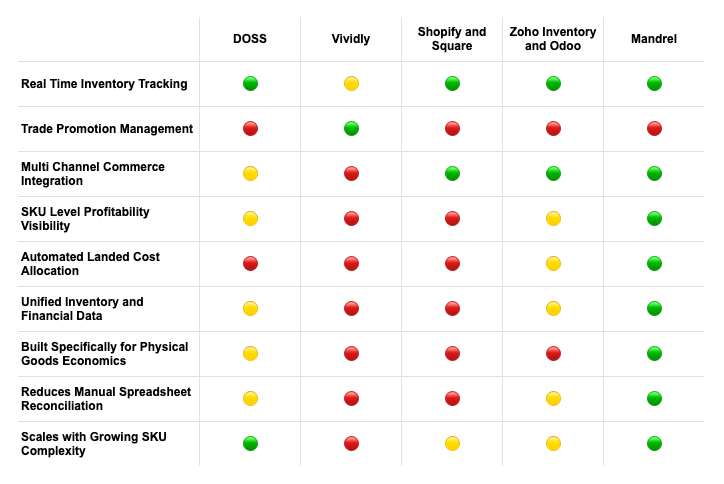
Choosing the right software is a big decision, but it doesn't have to be overwhelming. The best platform for you depends on your business size, complexity, and specific goals. Whether you're a fast-growing CPG brand, an e-commerce powerhouse, or a multi-channel retailer, there's a solution designed to meet your needs. Let's walk through some of the top contenders in the retail inventory space so you can find the perfect fit for your team.
1. Mandrel: the AI-native ERP for physical goods
If you’re running a business centered on physical products, you know that SKU-level data is everything. Mandrel is an AI-native ERP built from the ground up for this reality. It’s designed to give you a crystal-clear, real-time view of your revenue, costs, and inventory for every single SKU. What makes it stand out is its ability to automate tedious financial workflows, like allocating landed costs and recognizing revenue, with transaction-level accuracy. As its creators put it, "Mandrel is an AI-native ERP designed specifically for physical goods, offering advanced features that streamline inventory management, enhance supply chain visibility, and improve operational efficiency." It’s a powerful choice for brands that need reliable, audit-proof financials and deep operational intelligence to grow efficiently.
2. DOSS: Built for operational scaling
DOSS positions itself as an ERP built for scaling CPG brands, particularly in the $10M to $200M range. It is designed to support brands managing dozens of SKUs across multiple channels and handling co-packing or multi-stage production.
Where DOSS is strongest is operational control during rapid growth. However, like many growth-focused ERPs, its core emphasis is on production workflows and supply chain visibility. Brands that require deep, automated financial workflows, such as systematic landed cost allocation or transaction-level margin tracking, may still rely on additional accounting processes outside the platform. For teams seeking full finance and inventory unification in a single architecture, this can introduce complexity as they mature.
3. Vividly: Trade promotion first, inventory second
Vividly is purpose-built for trade promotion management. For CPG brands investing heavily in retail promotions and trade spend, it provides valuable forecasting and ROI visibility tools.
However, Vividly is not a full ERP. Inventory management exists within the context of trade spend optimization rather than as the operational backbone of the business. Companies using Vividly typically maintain separate systems for accounting, supply chain management, and SKU-level financial reporting. For brands seeking one unified source of operational and financial truth, this often means stitching multiple systems together.
4. Shopify: Commerce-first inventory
Shopify excels at enabling ecommerce. Its inventory tools are tightly integrated with checkout, order management, and storefront operations, making it an excellent solution for online-first retailers.
However, Shopify’s inventory functionality is designed to support sales workflows, not complex supply chain accounting. Advanced needs such as landed cost allocation across inbound freight, multi-entity reporting, or GAAP-aligned inventory valuation typically require external accounting software or third-party apps. As SKU counts and operational complexity grow, many brands outgrow the native inventory layer.
5. Square: Point-of-sale-centric control
Square is built primarily around point-of-sale operations. Its inventory management works seamlessly within retail environments, automatically updating stock levels as transactions occur.
The limitation is depth. Square is optimized for retail transaction tracking rather than supply chain or manufacturing workflows. Businesses with multi-warehouse distribution, complex purchasing, or SKU-level margin tracking requirements often need additional systems to manage financial accuracy and operational scale.
6. Zoho Inventory: Ecosystem-driven flexibility
Zoho Inventory is part of the broader Zoho ecosystem. It offers solid multi-channel inventory tracking and integrates smoothly with Zoho Books and Zoho CRM.
Its flexibility is a strength, but it is also generalized by design. Zoho is built to serve many industries, not specifically physical goods businesses. Achieving deep SKU-level financial insight or advanced landed cost automation may require additional configuration or reliance on accounting tools outside the inventory module.
7. Odoo: Modular and customizable
Odoo’s modular structure allows businesses to build a custom ERP by adding applications over time. This makes it appealing for teams that want flexibility and control over their system architecture.
The tradeoff is implementation complexity. Because Odoo is highly customizable, many businesses rely on integrators or internal technical resources to configure and maintain the system. For lean operator teams without dedicated technical support, long-term maintenance and financial workflow consistency can become challenging.
How much does inventory software cost?
Asking about the cost of inventory software is a bit like asking about the cost of a car. the answer really depends on what you need it to do. You can find everything from free, basic tools to powerful, enterprise-level systems with six-figure price tags. The final cost is shaped by factors like the size of your SKU catalog, the number of sales channels you operate, how many users need access, and the complexity of your financial workflows.
Think of it less as a cost and more as an investment in your operational backbone. The right software pays for itself by preventing stockouts, reducing carrying costs, and eliminating the expensive manual errors that can eat into your margins. As you evaluate options, consider not just the monthly subscription fee but also any one-time setup or implementation costs, as well as the level of customer support included. The goal is to find a platform that solves your immediate challenges while giving you a clear path to scale as your brand grows. A system that feels like a bargain today might become a bottleneck tomorrow if it can't keep up with your success.
Free and low-cost plans for small businesses
If you’re just getting your CPG brand off the ground, you don’t need to spend a fortune on software. Many platforms offer free or low-cost starter plans designed for emerging businesses. These are great for getting organized when you’re managing a small number of SKUs and selling through a single channel, like a Shopify store.
These plans typically cover the basics, like tracking stock levels and processing orders. However, they often come with limitations on the number of users, orders, or integrations. They’re a fantastic entry point, but be prepared to graduate to a more robust plan as your sales volume and operational complexity increase. Think of it as a launchpad. perfect for liftoff, but not built for a long-haul journey.
Mid-tier subscriptions for growing CPG companies
This is where things get interesting for most CPG brands. Once you’re managing multiple sales channels, a growing SKU catalog, and a more complex supply chain, you’ve outgrown the basic plans. Mid-tier solutions are built for this exact growth stage, offering a powerful balance of advanced features and manageable costs. Here, you’ll find essential tools like multi-warehouse support, demand forecasting, and automated purchasing.
These platforms are often designed to handle the specific challenges of CPG, like lot tracking and landed cost calculations. Many solutions in this category are built to support brands scaling through the critical $10M-$200M revenue range. An AI-native ERP like Mandrel fits right in this space, turning your SKU data into the financial intelligence you need to protect your margins as you grow.
Custom enterprise-level solutions
For large, established CPG companies with national or global distribution, off-the-shelf software often isn’t enough. At this scale, inventory management becomes one component of a comprehensive Enterprise Resource Planning (ERP) system like NetSuite. These solutions are custom-built to manage every facet of the business, from manufacturing and supply chain logistics to finance and human resources.
The investment here is significant, encompassing not just high subscription fees but also extensive implementation, customization, and team training. The return is a deeply integrated system that can streamline operations at a massive scale, providing a single source of truth for the entire organization. This level of control and insight is what allows major brands to manage complex product lines and distribution networks efficiently.
A recent episode of the BlueOcean by StartOps podcast previewed the future of inventory management software
Key features of Zoho's free plan
For small businesses just starting out, Zoho's free plan offers a solid set of tools to get organized. It provides a centralized system to manage your inventory across different sales channels, which is a huge step up from spreadsheets. You can track sales orders, create invoices, and manage supplier details all in one place. The main dashboard gives you a quick overview of your order statuses, showing what needs to be packed or shipped. It also includes features for tracking individual items using serial or batch numbers and can generate basic reports on sales history and inventory value. It’s a practical first step for getting organized without an initial investment, giving you the core tools to move beyond manual tracking.
Software for specific business needs
While a comprehensive ERP is the goal for many scaling brands, sometimes you need a specialized tool to solve a very specific problem right now. Whether you’re a manufacturer juggling raw materials or a retailer trying to sync inventory across a dozen online channels, there are platforms designed to excel at one particular job. These niche solutions can be a great starting point or a powerful supplement to your existing systems, helping you master a key part of your operations before you integrate everything into a single source of truth.
For manufacturing: Katana MRP
If you make your own products, your inventory needs go beyond just tracking finished goods. Katana is a manufacturing resource planning (MRP) tool built to manage the entire production process. It helps you keep track of all the raw materials and components needed for your products, alerting you before you run out of a critical ingredient. Its smart auto-booking engine automatically allocates materials to new orders as they come in, ensuring you have what you need to start production without delays. This level of control is essential for manufacturers looking to streamline their workshop and fulfill orders efficiently.
For multi-channel e-commerce: Ordero
Selling on Shopify, Amazon, and through wholesale channels is a great way to grow, but it can create an inventory nightmare. Ordero is designed to solve this exact problem by acting as your central hub for multi-channel inventory control. It keeps your product counts accurate across every platform you sell on, updating stock levels in real-time as sales happen. This instant synchronization prevents you from accidentally overselling a product that just sold out on another channel, helping you maintain a great customer experience and avoid the headache of canceling orders. It’s a must-have for any brand serious about expanding its online footprint.
For QuickBooks users: SOS Inventory
For businesses that have built their financial operations around QuickBooks, SOS Inventory is a natural next step for getting more control over stock. It’s designed to enhance the native inventory features within QuickBooks, adding more advanced capabilities without forcing you to migrate to a new accounting system. A key feature is its ability to track items by lot and serial number, which is a non-negotiable for businesses in industries like food and beverage or electronics that require precise traceability for quality control and recalls. It’s an ideal solution for adding operational depth to your existing financial setup.
For asset tracking: Sortly
Not everything in your warehouse is for sale. Tools, equipment, and machinery are valuable assets that also need to be tracked. Sortly is a user-friendly, mobile-first app designed specifically for asset tracking rather than sales inventory. It simplifies the process of knowing what you have and where it is, using features like barcode and QR code scanning to make data entry quick and accurate. This is perfect for keeping tabs on high-value equipment across different job sites or within a large facility, ensuring nothing gets lost and everything is accounted for, which is crucial for both operations and accounting.
Pricing examples: Square and SOS Inventory
To give you a clearer picture, let's look at a couple of specific examples. Square’s inventory management software is integrated into its broader Point of Sale (POS) system, making it a natural fit for brick-and-mortar retailers. It helps you track what you have, what’s selling, and what you need to order. You can start with basic inventory features for free, which is great for new businesses. As you grow, you can move to a paid plan like Square Plus ($49 per month per location) or Square Premium ($149 per month per location) to access more advanced tools.
For businesses that already run their accounting on QuickBooks, SOS Inventory is a popular choice because it’s built to enhance QuickBooks’ native tools. Its standout feature is the ability to track items by lot and serial number. This is non-negotiable for brands in food, supplements, or electronics, where precise traceability is essential for things like managing expiration dates or handling a product recall. Pricing for SOS Inventory starts at $64.95 per month for two users, with options to add more team members as you scale.
Pricing examples: Katana, Inflow, and Ordero
To give you a clearer picture of the investment, let's look at a few specific examples. For businesses that physically make their own products, a tool like Katana MRP is a popular choice. It helps manage raw materials and production steps, a process known as Manufacturing Resource Planning (MRP), with pricing that starts at $179 per month for basic tracking and goes up to $799 per month for more advanced forecasting and reporting. If your focus is more on managing high sales volume, inFlow offers plans starting at $186 per month for small teams and scaling to $999 per month for larger operations handling thousands of orders. For brands selling across multiple channels like Amazon and Shopify, Ordero specializes in keeping your stock counts accurate everywhere. Its advanced plan is $349 per month and includes unlimited users and warehouses, which is ideal for fast-growing, multi-channel businesses.
Solve common inventory challenges with the right software
Choosing the right inventory software isn't just about tracking stock. It's about building a resilient foundation for growth. The right platform directly addresses the most common and frustrating hurdles that CPG brands face as they scale. From tangled production schedules to inaccurate stock counts, software brings clarity and control to your operations, freeing you up to focus on building your brand.
Manage large SKU catalogs and complex production
As your brand grows, so does your SKU count. Managing 50+ SKUs with complex production needs using spreadsheets is a recipe for disaster. Inventory management software is built to handle this complexity, giving you a central hub to track raw materials, work-in-progress, and finished goods. This SKU-level visibility is critical for brands in a hypergrowth phase, ensuring you can manage intricate supply chains and production runs without losing your grip on the details. It allows you to see exactly what you have, where it is, and what you need to order, preventing costly delays and stockouts that can stall your momentum.
Eliminate stock inaccuracies across channels
Selling across multiple channels is great for revenue but can create chaos for your inventory. A sale on your website needs to be reflected instantly in your wholesale and retail systems to prevent overselling. The right software provides a single source of truth, syncing inventory levels in real time across all your sales channels. This eliminates the guesswork and manual updates that lead to embarrassing stockouts or holding onto excess inventory. You can confidently sell on your website, through retail partners, and on marketplaces, knowing the stock numbers your team and your customers see are always accurate.
Streamline trade promotions and financial workflows
For CPG brands, trade promotions are a powerful sales tool but a nightmare to track financially. Software can help you manage promotional spending, deductions, and overall campaign profitability with much greater precision. By integrating these activities, you can see the true financial impact of a promotion instead of guessing. Platforms with automated financial workflows connect sales data directly to your books, giving you a clear picture of your margins and helping you make smarter decisions about future promotions. This ensures your marketing spend is actually driving profitable growth.
Reduce manual errors and improve efficiency
Manual data entry is not only slow but also prone to human error. A simple typo in a spreadsheet can lead to costly ordering mistakes, stockouts, or excess inventory. Inventory management software automates repetitive tasks like reordering, data ingestion, and reporting. This significantly reduces the risk of manual errors and gives your team back valuable time. Instead of spending hours reconciling numbers or chasing down information, they can focus on strategic initiatives that actually grow the business, like analyzing sales trends or improving supplier relationships.
Related articles
- SKU-Level Economics: What Your Gross Margin Isn’t Telling You
- What Is a Warehouse Inventory Management System?
- Landed Costs: Not Just Another Financial Metric
- Turn POs into Profits: Strategies for Optimizing Purchase Orders
- Navigating The Impact of Tariffs on Margins
Frequently asked questions
When is the right time to switch from spreadsheets to actual inventory software?
The tipping point is usually when the time you spend managing your spreadsheets starts to cost more than the software itself. If you find yourself constantly worried about overselling, spending hours manually updating stock counts after a big sales day, or struggling to get a clear picture of your best and worst-selling products, it's time. Think of it as a sign of success. your business has grown too complex for a manual system to keep up, and you need a real tool to support the next stage of growth.
What’s the real difference between inventory management software and an ERP?
Think of it this way: inventory management software is a specialist that does one job exceptionally well. tracking your products. An Enterprise Resource Planning (ERP) system is more like a general contractor for your entire business. It connects inventory with finance, sales, and operations into one unified system. Modern, AI-native ERPs like Mandrel are built specifically for physical goods, giving you that deep inventory specialization within a fully connected business framework.
How much work is involved in getting new inventory software set up?
Getting started is a project, but it shouldn't be a painful one. The process typically involves migrating your product data (like SKUs and supplier info) into the new system and training your team on how to use it. The best software providers offer dedicated support to guide you through this. While it requires an upfront investment of time, the long-term payoff is huge. You're trading a few weeks of focused effort for years of streamlined operations and fewer manual headaches.
My products have expiration dates and lot numbers. Can this kind of software handle that?
Yes, and this is a critical feature to look for if you're a CPG brand. Basic inventory tools might not offer this, but any software built for physical goods will have features for lot tracking and managing expiration dates. This is essential for quality control, managing recalls, and ensuring you follow a first-in, first-out (FIFO) system so you aren't left with unsellable products. It’s a non-negotiable for anyone in the food, beverage, or beauty space.
With so many options, how do I choose the best software for my specific business?
Start by making a simple list of your top three inventory challenges. Are you struggling with overselling across channels? Are landed costs eating into your margins? Do you have no idea how your trade promotions are performing? Use this list as your guide. During demos, ask providers to show you exactly how their platform solves your specific problems. The right software will feel less like a generic tool and more like a direct solution to your daily operational hurdles.