
Are you making decisions for the business you have today or the one you had last month? For many leaders, the answer is the latter. The traditional month-end close delivers financial reports so late that the insights are already history. By the time you see your margins, your inventory has moved and your costs have changed. This delay is a direct result of a manual, backward-looking process. In this article, we’ll dissect the steps of the close, pinpoint why it creates this critical information gap, and explore how modern systems provide the real-time visibility needed for smarter, faster decisions.
At the end of every month, finance teams pause their normal work and begin a strange ritual called “closing the books.” For several days (and sometimes weeks), they scramble to assemble a coherent picture of what just happened in the business.
They chase down missing invoices.
They reconcile warehouse counts with ERP records.
They allocate freight costs across shipments.
They update spreadsheets that track inventory, purchase orders, and landed costs.
Only after all of that work can they produce financial statements that supposedly describe the previous month.
For decades, this ritual was the best way to understand a business’s operations. But with this delayed visibility, leaders often ended up making decisions for a business that no longer exists. That gap was especially consequential for companies managing physical inventory, where every operational event (from purchase orders to freight invoices to warehouse receipts) impacts inventory value and cost of goods sold. The good news is that recent advances now make it possible to see how a business is operating in real time, rather than reconstructing it weeks after the fact.
What is the month-end close?
The month-end close is the process of reviewing, reconciling, and finalizing a company's financial records for the previous month. Think of it as a monthly financial check-up. The accounting team gathers all the transaction data from the last 30 days—every sale, purchase, bill, and payment—to ensure everything is recorded accurately. This process is crucial for any business, but it's especially complex for companies that sell physical products. For these businesses, the close involves tracking inventory movements, allocating shipping costs, and calculating the cost of goods sold, all of which directly impact the bottom line. The end goal is to produce a set of reliable financial statements that show exactly how the business performed.
The formal definition of the month-end close
At its core, the month-end close is an accounting procedure designed to finalize all financial activity for the preceding month. It’s a structured process that verifies and adjusts account balances to prepare for the new accounting period. According to the financial automation experts at BlackLine, this is the point where the books are officially "closed," meaning no more transactions can be posted to that period. This creates a clean cut-off, ensuring that financial reports for one month don't bleed into the next. It’s a fundamental practice that establishes a consistent rhythm for financial reporting and analysis, providing a clear and accurate snapshot of the company's financial position at a specific point in time.
What are the goals of the month-end close?
The primary goal of the month-end close is to ensure all financial records are correct and up-to-date. This isn't just about ticking boxes for compliance; it's about generating trustworthy data that leaders can use to make smart decisions. As the team at HighRadius explains, this process helps businesses understand their financial health, plan for the future, and manage cash flow effectively. For a CPG brand, this means knowing your true profit margins on each product, understanding your inventory holding costs, and having the confidence to invest in growth. It also builds trust with investors, prepares you for tax season, and makes any potential audits much less painful.
The key outputs: your core financial statements
The month-end close culminates in the creation of your company's core financial statements. These reports are the ultimate summary of your business's performance. The two most critical outputs are the balance sheet and the profit and loss (P&L) statement. The balance sheet provides a snapshot of what your company owns (assets) and what it owes (liabilities) at the end of the month. The P&L, also known as the income statement, shows how much money the business made or lost over that period. For product-based businesses, getting these right depends on accurate, SKU-level data, as your inventory value and cost of goods sold are major components of these statements.
A step-by-step look at the month-end close process
The month-end close isn't a single event but a series of steps that can be grouped into three main phases: the pre-close, the execution, and the post-close. Each phase has its own set of tasks that build on the last, moving from data collection to final analysis. While every company’s process is slightly different, this three-phase structure is a standard framework used by accounting teams everywhere. Understanding these stages helps demystify the process and highlights where bottlenecks often occur, especially for businesses managing complex inventory and supply chains. Let's walk through what happens in each phase to see how a month of business activity gets condensed into a few key reports.
Phase 1: The pre-close
The pre-close is all about preparation. Before the month even ends, the accounting team starts getting organized to ensure a smooth process. This phase involves gathering all the necessary financial information and preliminary data. According to Ramp, this includes collecting details about income, expenses, and daily transactions. For a CPG company, this means tracking down freight invoices, warehouse receiving reports, and purchase orders. The goal is to have as much information as possible ready to go on day one of the close. A well-organized pre-close can significantly speed up the entire process by minimizing the last-minute scramble for missing documents and data.
Phase 2: The execution
This is where the real work of the month-end close happens. During the execution phase, the accounting team dives into the data collected during the pre-close to record, reconcile, and adjust the books. This is the most intensive part of the process, requiring meticulous attention to detail to ensure every number is accurate and accounted for. It involves everything from matching bank statements to making complex calculations for accrued expenses. For businesses with physical goods, this phase is particularly challenging due to the complexities of inventory accounting, landed cost allocation, and revenue recognition. This is where manual processes and disconnected spreadsheets can really slow things down.
Recording transactions and reconciling accounts
The first step in the execution phase is to record all transactions and reconcile key accounts. This means ensuring the numbers in your accounting system match the numbers in your bank and credit card statements. As the experts at QuickBooks note, this involves matching every deposit, withdrawal, and charge to an entry in your general ledger. Any discrepancies must be investigated and resolved. This foundational step confirms that all cash movements are accounted for, providing a solid, verified baseline before moving on to more complex adjustments and reviews.
Reviewing balance sheet accounts
After reconciling cash, the focus shifts to other key balance sheet accounts. This involves verifying the balances for accounts receivable (money owed to you), accounts payable (money you owe), and fixed assets. For companies selling physical products, the most critical and often most difficult account to review is inventory. This requires confirming that the value of inventory on your books matches the physical count and that all associated costs, like freight and duties, have been properly allocated. Getting this right is essential for an accurate balance sheet and a reliable cost of goods sold figure on your P&L.
Making adjusting entries
Adjusting entries are made to account for revenues and expenses that aren't reflected in daily transaction records. This step ensures your financial statements adhere to the accrual basis of accounting, which means recording economic events when they happen, not just when cash changes hands. This includes recording expenses that have been incurred but not yet paid (accruals) and spreading out prepaid expenses over the correct time periods (deferrals). For example, you might accrue for wages earned by employees in the last week of the month but not paid until the next, ensuring the expense is recognized in the period it occurred.
Phase 3: The post-close
Once all accounts are reconciled and adjusting entries are posted, the accounting period is officially closed. In this final phase, the finance team runs the financial statements—the P&L, balance sheet, and cash flow statement. The team then performs a final review and variance analysis, comparing the actual results to the budget or forecast to understand business performance. This is also when they prepare reports and presentations for leadership. While this analysis is critical, it's often based on data that is already a week or more old, highlighting the inherent delay in the traditional close process.
How long should the month-end close take?
The time it takes to close the books can vary widely from one company to another, depending on the complexity of the business, the systems in use, and the efficiency of the accounting team. A small business with simple operations might close in a day or two, while a large corporation with multiple subsidiaries could take weeks. However, for most growing CPG brands, the process is a multi-day affair filled with manual data entry and reconciliations. The length of the close cycle is a key performance indicator for finance teams, as a shorter close means that leaders get critical financial information faster, allowing them to make more timely and informed decisions.
Industry benchmarks for closing the books
So, what’s a typical timeline? According to data from Ramp, the median time to complete a month-end close is 6.4 days. The report also notes that only 18% of finance teams manage to finish in three days or less, while half of all teams take more than five business days. This delay means that by the time leadership sees the financial reports, the month is already a quarter of the way over. For fast-moving businesses, making decisions based on week-old data is a significant handicap. This is why many companies are turning to modern, automated systems like AI-native ERPs to get real-time financial visibility without waiting for the month-end scramble.
Why is the month-end close so painful for inventory businesses?
In software companies, revenue and cost data are relatively straightforward. Transactions occur inside a small set of systems, and financial reporting can often be generated directly from them.
Inventory businesses, however, operate very differently.
The financial story of a physical product business depends on a long chain of operational events.
- A purchase order is issued
- A supplier confirms production
- A shipment leaves a factory
- Containers move across the ocean
- Freight invoices arrive
- Goods are received at a warehouse
- Orders are fulfilled to customers
Each event affects both inventory value and cost of goods sold, but the data describing these events rarely lives in one place.
- Purchase orders may exist in spreadsheets.
- Shipping updates arrive through email.
- Warehouse activity sits inside a WMS.
- Sales data comes from ecommerce platforms.
- Freight costs show up on invoices days or weeks later.
By the time finance teams try to close the books, they’re not just reviewing a system of record. They’re reconstructing the financial consequences of dozens of operational events spread across disconnected systems.
This is why closing the books for an inventory-driven business often takes weeks instead of days. It's not just an accounting exercise. It is a reconstruction project.
Common challenges that slow down the close
This reconstruction project is tough because finance teams are working against a few common enemies. The biggest culprit is often the sheer amount of manual work involved—endless spreadsheets, chasing down invoices, and manually reconciling data from different sources. Information is scattered everywhere, from the warehouse management system to email inboxes, creating significant information gaps and forcing teams to piece together a financial story from incomplete data. On top of that, poor communication between operations, logistics, and finance means that by the time the accounting team gets the information they need, it’s already old news. Without a single, reliable source of truth, the entire process becomes a slow, error-prone scramble to meet deadlines.
Are you the 'human API' in your month-end close?
At the center of this problem is a role that almost no one explicitly talks about: the human integration layer between systems.
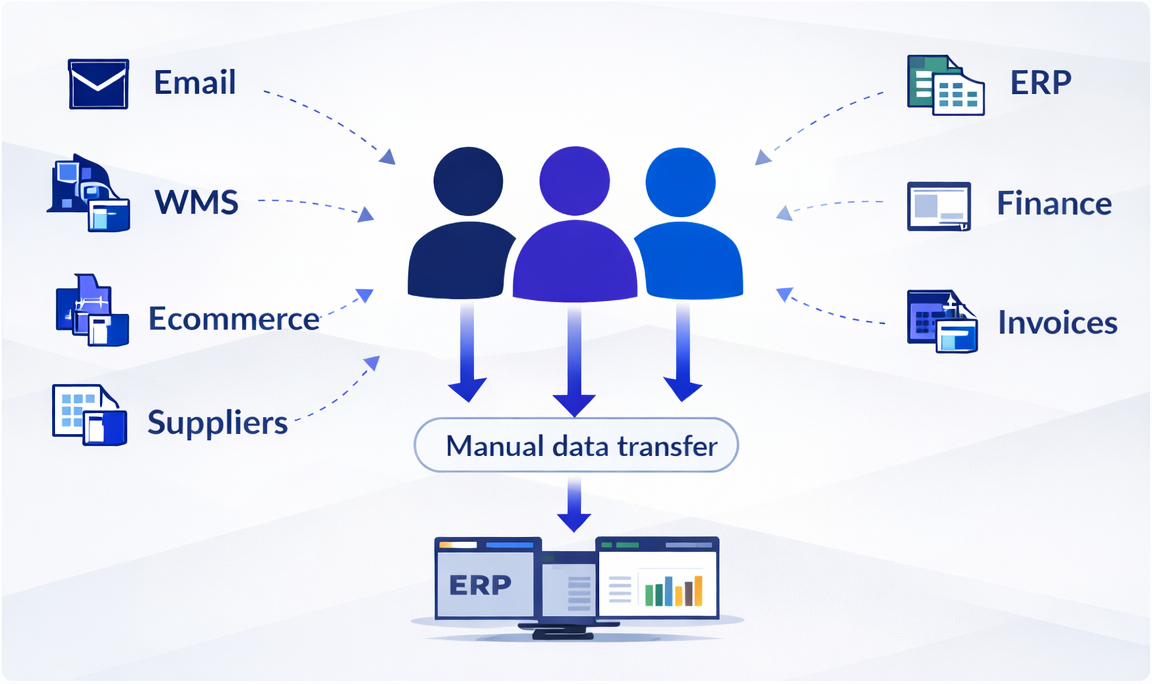 In most organizations, operational data doesn't flow automatically between systems. Instead, people manually transfer information from one place to another.
An operations analyst updates a spreadsheet when a shipment leaves a supplier. A finance team member enters an invoice into the ERP. Someone adjusts inventory values after a freight bill arrives. Someone else reconciles warehouse counts with accounting records.
In effect, employees become the API that connects the real world to the company’s software:
- They read emails.
- They open documents.
- They enter data.
- They update statuses.
This work is essential, but it's also extremely time-consuming and error-prone. Month-end close is simply the moment when all those manual translations are finally reconciled. If data were captured automatically and continuously updated, much of the work of closing the books would already be done before the month ended.
If data were captured automatically and continuously updated, much of the work of closing the books would already be done before the month ended.
BLOG: SKU-Level Economics: What Your Gross Margin Isn’t Telling You
It’s a team sport, not a solo race
The month-end close might feel like a burden that falls squarely on the finance team, but it’s truly a company-wide effort. As the team at Ramp puts it, the close is a team effort that needs input from many departments, not just accounting. For businesses managing physical goods, this is especially true. Your operations team has the latest on purchase orders and shipment statuses. Your warehouse team knows what inventory has actually been received. Your sales team has the data on what’s been sold. The finance team’s job is to collect all these pieces and translate them into a financial story, but they can’t do it alone. Clear communication and collaboration are essential to piecing together an accurate picture without the last-minute scramble.
Why the process looks different for every company
There’s no one-size-fits-all template for closing the books. The process can and should look different for every company, because every business model is unique. A software company’s close is relatively simple, focusing on revenue recognition for subscriptions. But for a CPG brand, the process is far more complex. You have to account for physical inventory, calculate the cost of goods sold for every SKU, and accurately allocate landed costs like freight and duties. The specific steps you take will depend on your supply chain complexity, your sales channels (DTC, wholesale, or both), and the systems you use to track everything from purchase to final sale.
Best practices for a smoother month-end close
Knowing that the close is a painful, manual reconstruction project is one thing; fixing it is another. While the ultimate goal is to move away from the frantic month-end ritual toward a state of continuous, real-time insight, you don’t have to wait for a complete system overhaul to make improvements. Implementing a few best practices can bring much-needed structure and clarity to your current process. These strategies are designed to reduce the reliance on that "human API," minimize errors, and create a more predictable and less stressful close for everyone involved. They lay the groundwork for a more efficient financial operation, whether you’re using spreadsheets or a modern ERP.
Use a standardized checklist
If you don’t have a month-end close checklist, this is the place to start. A standardized checklist is your single source of truth for the entire process, ensuring every task is completed consistently every single month. It’s a simple but powerful tool that, according to HighRadius, makes the process smoother, reduces errors, and helps with audits. For an inventory business, your checklist should include items like reconciling purchase orders with supplier invoices, confirming warehouse receipts against advance shipping notices, reviewing inventory valuation, and allocating freight costs across all relevant SKUs. This simple document transforms the close from a chaotic scramble into a repeatable, manageable process.
Assign clear roles and responsibilities
A great checklist is only effective if everyone knows which tasks they own. Ambiguity is the enemy of an efficient close. When responsibilities are unclear, tasks get missed, deadlines slip, and the finance team is left chasing down information at the last minute. To avoid this, make sure every single item on your checklist has a clear owner and a due date. For example, the supply chain manager is responsible for providing final freight costs, while the e-commerce manager needs to submit a report on promotional discounts. This simple act of assigning ownership creates accountability and ensures the process keeps moving forward without constant follow-up.
Make it a continuous process
Why squeeze a month’s worth of financial work into a few frantic days? The most effective way to ease the month-end burden is to stop treating it as a once-a-month event. Instead, you should handle closing tasks throughout the month. This approach, often called a "continuous close," spreads the work out and provides a much clearer picture of the business at any given moment. You can reconcile bank and credit card transactions weekly, record invoices as they arrive, and update inventory costs as new information becomes available. This is where an AI-native platform can be a game-changer, automating data ingestion and reconciliation to give you a real-time view of your finances long before the month officially ends.
Prioritize accuracy over speed
There’s often immense pressure to close the books as quickly as possible so leaders can get the financial reports. However, rushing the process can lead to costly mistakes. Inaccurate financial statements can lead to poor strategic decisions, issues during audits, and a loss of confidence from investors or lenders. It’s far better to take an extra day to ensure the numbers are right than to rush and present a flawed picture of the company’s performance. The ultimate goal isn’t just a faster close, but a more reliable one. By improving your underlying processes and systems to capture data correctly the first time, you can achieve both speed and accuracy.
Moving from a monthly scramble to continuous clarity
Imagine a different model.
Operational data flows automatically into a central system as events occur. Documents such as invoices, packing lists, and freight bills are captured the moment they arrive. Inventory movements update in real time as goods move through the supply chain. Costs are allocated continuously as new information becomes available.
Instead of waiting until the end of the month to calculate landed costs, inventory value, and cost of goods sold, those numbers update dynamically as the business operates.
In this world, the company's financial position is always current. Finance teams no longer need to reconstruct the past. They can observe the present.
Month-end close still exists for reporting and compliance purposes. But it becomes a confirmation process rather than a reconstruction effort. The books are effectively always closed.
For companies that operate complex supply chains, this shift is more than a productivity improvement. It fundamentally changes how leaders make decisions.
When financial and operational data move together in real time, companies gain immediate visibility into margins, inventory value, and working capital.
Instead of waiting weeks for the numbers, leaders can respond to what is happening in the business right now.
And that is the real opportunity.
The goal shouldn't be to make month-end close faster. The goal should be to stop reconstructing the past and start taking advantage of real-time insights.
The problem with manual processes and spreadsheets
When your operational data is scattered across different systems, someone has to connect the dots. In most growing businesses, that "someone" is a team of people manually transferring information from one place to another. This work is not just tedious; it's a huge source of risk. Every time a number is copied from an invoice to a spreadsheet or from a warehouse management system into an ERP, there's a chance for a typo or a miscalculation. These small errors compound over the month, creating discrepancies that can take days to untangle. By the time finance teams try to close the books, they aren’t just reviewing a system of record. They’re reconstructing the financial consequences of dozens of operational events spread across disconnected systems, hunting for the source of a single inconsistency.
How automation creates a faster, more accurate close
Now, let's picture a different model where operational data flows automatically into a central system as events occur. Documents like invoices and packing lists are captured and processed the moment they arrive. Instead of waiting until the end of the month to calculate landed costs or inventory value, those numbers update dynamically as your business operates. This is the power of an AI-native ERP built for physical goods. The month-end close still happens for reporting and compliance, but it becomes a simple confirmation process rather than a frantic reconstruction effort. Your team can shift its focus from chasing down data to analyzing it, providing the real-time insights needed to make smarter decisions about purchasing, pricing, and inventory throughout the month.
Related articles
- What “AI-Native ERP” Actually Means (And What It Doesn’t)
- Spreadsheets, IMS, or ERP? The Architecture Question Most Brands Miss
- SKU-Level Economics: What Your Gross Margin Isn’t Telling You
- Landed Costs: Not Just Another Financial Metric
- Turn POs into Profits: Strategies for Optimizing Purchase Orders
Frequently asked questions
My numbers are accurate, so does it really matter if our close takes over a week? Accuracy is essential, but it's only half the battle. The problem with a long close is that it delivers a perfect picture of a business that no longer exists. By the time you get your reports, your inventory levels have changed, new costs have come in, and market conditions may have shifted. Making decisions based on week-old data means you're always reacting to the past instead of proactively managing the present. The real goal is to have accurate numbers available in real time, so you can make smarter choices about purchasing, pricing, and cash flow today.
What's the difference between a 'continuous close' and just doing our regular closing tasks more often? It's a fundamental shift in mindset and process. Doing tasks more often, like reconciling bank accounts weekly, is a great step toward a smoother close. A true continuous close, however, is about having systems that automatically capture and process financial data as operational events happen. Instead of manually allocating a freight invoice at the end of the month, the system does it the moment the invoice is received. This means your books are effectively always current, turning the month-end close from a frantic reconstruction project into a simple review and confirmation process.
We're a small team. Is it realistic to automate our month-end close? Absolutely. In fact, automation is even more critical for small teams who can't afford to have their best people tied up in manual data entry. Modern systems are designed to handle the heavy lifting that used to require a large finance department. By automating tasks like document ingestion, cost allocation, and reconciliation, you free up your team to focus on strategic analysis that actually drives the business forward. It’s not about replacing your team; it’s about equipping them with better tools to manage growth effectively.
What's the single biggest mistake companies make during the month-end close? The biggest mistake is treating the close as a purely financial exercise that happens in isolation. The numbers in your financial statements are a direct result of operational activities that happen all month long across your supply chain, warehouse, and sales channels. When finance is disconnected from these departments, they spend the close chasing information and trying to piece together a story from scattered data. The most successful companies view the close as a team sport, ensuring information flows freely and automatically between operations and finance throughout the month.
Besides using a checklist, what's one practical step I can take this month to improve our process? A great next step is to hold a brief "pre-mortem" meeting with key people from operations, logistics, and finance a few days before the month ends. Go over the major activities of the past few weeks, like large shipments that arrived or unexpected freight charges. This gives the finance team a heads-up on complex transactions they'll need to account for. It helps turn the close from a reactive scramble into a more coordinated effort, reducing last-minute surprises and the time spent hunting for information.
Key Takeaways
- The traditional close is a reconstruction project, not a report: For businesses with physical inventory, the month-end close involves piecing together data from disconnected systems like spreadsheets and emails. This manual effort means you're making decisions based on what your business looked like weeks ago, not today.
- Simple habits can create a smoother process: You can reduce the month-end scramble by implementing practical steps now. Use a standardized checklist, assign clear ownership for each task, and shift to a continuous process by handling reconciliations and data entry throughout the month.
- The goal is continuous clarity, not just a faster close: The real solution isn't just speeding up the monthly ritual; it's making it obsolete. By automating data capture with a central system, your financials can update in real time, giving you an always-current view of your business for smarter, faster decisions.