.png)
Spend any time in the enterprise software world, and you’ll quickly notice everything has suddenly become “AI-native.” Accounting tools, supply chain systems, and of course, countless ERP platforms now carry the label. At this point, the phrase is so overused it’s starting to lose its meaning. Many companies apply it after adding just one simple AI feature. But a true AI-native ERP is something different entirely—it’s a specific architecture that can materially change how a business operates. This article cuts through the marketing noise to explain what it actually is and why it matters.
Accounting tools are “AI-native.” Supply chain systems are “AI-native.” And, close to my heart, ERP platforms abound that are “AI-native.”
At this point, the phrase is becoming so overused that it’s starting to lose meaning. Many companies now apply the label whenever they add an AI feature to an existing product. But “AI-native” actually refers to a specific architectural paradigm that can materially change how a business operates.
In this blog, I’ll cut through the marketing noise and explain what it actually means to be a true AI-native ERP.
Why bolting AI onto your old ERP doesn't work
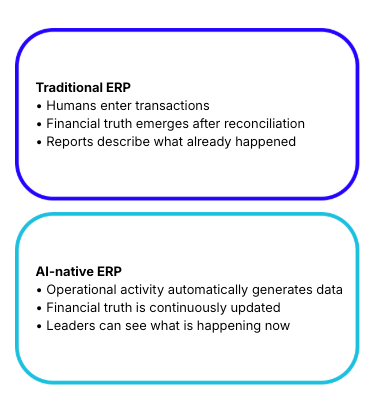
Traditional ERP systems were built primarily as systems of record. Their job was to store transactions and produce financial reports. In practice, that architecture relied on several assumptions about how business data should be captured and maintained:
- Humans enter transactions into the system
- Data is manually updated as operations occur
- Financial truth is calculated periodically (usually monthly)
- Reconciliation happens across multiple systems and spreadsheets
That architecture made perfect sense in an earlier generation of software. Businesses were smaller, data volumes were lower, and reporting cycles were slower. But the model hasn’t changed much, even as the business ecosystems they were meant to serve grew more complex.
Fast forward to today, and to address the gap, many traditional vendors are adding AI features to these same systems. You might see an LLM-powered chat interface that lets you ask questions about your ERP data. Or an AI assistant that summarizes reports and dashboards. Some platforms now offer copilots that help users navigate menus or generate queries.
To be sure, these features can absolutely be helpful, but they don’t fundamentally change how the system works. If the ERP still relies on people manually entering and maintaining data, the AI is ultimately analyzing incomplete, delayed, or already outdated information. In those cases, AI becomes a layer on top of the system rather than something built into its foundation.
And that’s the key distinction.
What makes an ERP system truly AI-native?
A true AI-native ERP starts with a very different assumption. Instead of requiring humans to constantly update the system, the system should update itself.
In this model, data capture occurs automatically across the tools and communications already in use in the business. Operational events, documents, and system updates continuously feed the platform, enabling it to maintain an accurate, real-time picture of what’s happening.
Rather than waiting for someone to enter transactions and reconcile spreadsheets, the system continuously reflects real-world activity as it unfolds.
This represents a shift in what ERP software actually does.
- Traditional ERP systems (even those with AI add-ons) function as systems of record. They document what’s already happened.
- AI-native ERP systems function more like systems of intelligence. They help operators understand what’s happening right now.
A modern, AI-native ERP opens a number of intriguing possibilities. Businesses gain real-time visibility into inventory, costs, and operational activity. Decisions can be made using live financial and operational data instead of waiting for end-of-month reports. Teams spend less time assembling spreadsheets and more time interpreting the information already available to them.
This shift is particularly important for inventory-based businesses operating in environments where small changes in costs, freight, or timing can materially impact margins. Inventory moves across suppliers, manufacturers, warehouses, and customers. And the economics of the business are ultimately determined at the SKU level.
When financial truth is calculated weeks or months after the fact, leaders are often forced to operate with partial information. Product-level economics may remain unclear until long after key operational decisions have already been made.
An AI-native system enables relevant data to be tracked continuously throughout the lifecycle of an item. Instead of waiting for periodic updates, companies can understand the real economics of their products in near real time.
Automate core financial and operational tasks
One of the most significant shifts with an AI-native ERP is moving from manual data entry to automated data ingestion. Instead of people telling the system what happened, the system observes what’s happening in real time by connecting to your other tools and documents. This allows it to automate core workflows that have traditionally been time-consuming and prone to error, freeing up your team to focus on more strategic work.
Handle core accounting with ease
Imagine an accounting system that handles the tedious work for you. AI-native platforms can automate the majority of the month-end close process, with built-in features for complex tasks like revenue recognition and invoicing. For businesses dealing with physical goods, this means AI can automatically ingest documents like purchase orders and invoices, match them, and even allocate landed costs down to the SKU level, ensuring your books are always accurate and compliant with GAAP.
Manage complex, multi-entity businesses
As your business grows, complexity multiplies. You might expand into new sales channels, set up different legal entities, or manage multiple warehouses. An AI-powered ERP is designed to handle this complexity without overwhelming your team. It can consolidate data from various sources, manage inter-company transactions, and provide a clear, unified view of your entire operation, making it much easier to manage a growing, multi-faceted business from a single platform.
Streamline operational workflows
The ultimate goal for many finance teams is a faster, more efficient close. Some AI-native platforms are even designed to achieve a "Zero-Day Close," where the books are essentially always up-to-date. This is possible because operational and financial data are no longer siloed. When inventory is received at a warehouse or an order is shipped to a customer, the financial impact is recorded automatically, eliminating the traditional delays and manual reconciliation between different departments.
Stay audit-ready from day one
Audits can be a stressful, time-consuming scramble to gather documents and justify numbers. Because an AI-native ERP captures and processes data automatically, it creates an immutable, transaction-level audit trail for every single event. From the initial purchase order to the final sale, every cost and revenue entry is traceable back to its source document. This means your business can be continuously audit-ready, giving you, your investors, and your auditors confidence in the numbers.
See measurable improvements in efficiency
Beyond just automating tasks, a true AI-native ERP delivers tangible results you can see in your team’s productivity and your company’s bottom line. By reducing manual work and providing real-time insights, these systems allow you to operate more efficiently, make smarter decisions, and grow your business without needing to proportionally increase your headcount.
Cut manual tasks and automate operations
Think about how much time your team currently spends on manual data entry, cross-referencing spreadsheets, and correcting errors. AI-native systems can cut out up to 90% of these manual tasks. By automating everything from invoice processing to cost allocation, the system frees your team from repetitive work. This allows them to focus on higher-value activities like analyzing trends, optimizing inventory, and planning for future growth.
Close your books in days, not weeks
The month-end close is a notorious bottleneck for many finance teams, often taking weeks of painstaking work. With automated data ingestion and real-time reconciliation, an AI-native ERP can shrink that timeline dramatically. When your financial records are continuously updated throughout the month, the closing process becomes a simple matter of review and final adjustments, allowing you to close your books in a matter of days, not weeks.
Improve forecasting and supply chain performance
For any business that sells physical products, profitability lives or dies at the SKU level. An AI-native ERP gives you real-time visibility into your inventory, costs, and margins for every single item. This granular insight allows for much more accurate demand forecasting and smarter supply chain management. You can make better purchasing decisions, optimize stock levels to avoid stockouts or overstocking, and confidently know your true product margins at all times.
Scale transactions without scaling your team
Growth is exciting, but it often comes with the challenge of scaling your back-office operations. An AI-native ERP is built to handle a massive volume of transactions without requiring more people to manage them. In fact, some platforms enable businesses to process ten times the number of transactions with the same size team. This means you can pursue aggressive growth, expand into new markets, and increase order volume without your operational costs spiraling out of control.
Get answers instantly with conversational AI
One of the most user-friendly innovations in AI-native ERPs is the ability to interact with your data through natural language. Instead of navigating complex menus or asking a data analyst to build a custom report, you can simply ask questions in plain English. For example, you could ask, "What was our gross margin on our top-selling SKU last quarter?" and the system’s AI will instantly analyze your financial data and provide an accurate answer, complete with supporting details.
Go live quickly with seamless integration
The thought of implementing a new ERP often brings to mind long, expensive, and disruptive projects. AI-native systems are changing that narrative. Built with modern architecture and a focus on user experience, these platforms are designed for rapid implementation and seamless connectivity with the other tools you already use to run your business.
Implement in weeks with little to no fees
Unlike legacy systems that can take over a year to implement, a modern AI-native ERP can be up and running in a matter of weeks. Because these platforms are cloud-based and designed for self-service, the setup process is much simpler and more intuitive. Many vendors offer expert-guided onboarding to ensure a smooth transition, allowing you to start seeing value from your new system almost immediately, without the hefty implementation fees of the past.
Connect with thousands of other tools
Your ERP doesn’t operate in a vacuum. It needs to connect with your ecommerce platform, 3PL, payroll system, and other business-critical applications. AI-native ERPs are built with open APIs, enabling them to easily connect to thousands of other software tools. This creates a cohesive tech stack where data flows automatically between systems, ensuring that your ERP always has a complete and up-to-date picture of your business operations.
Create a single source of truth for finance and operations
Ultimately, the goal of any ERP is to provide a single, reliable source of truth for the entire business. By unifying financial and operational data in real time, an AI-native ERP ensures that everyone—from the warehouse floor to the executive suite—is working from the same playbook and making decisions based on the same accurate information.
Empower small teams to operate like large enterprises
An AI-native ERP can level the playing field, giving smaller, leaner teams the same capabilities that were once only available to large corporations. By automating complex processes and providing instant access to critical data, these systems empower your team to be more strategic and efficient. This reduces the reliance on a patchwork of spreadsheets and disparate tools, allowing you to operate with the sophistication of a much larger enterprise.
Built by finance experts for finance teams
The best AI-native ERPs are designed by people who have firsthand experience with the challenges they’re solving. When a platform is built by finance and operations experts, it’s tailored to the specific workflows and needs of its users. At Mandrel, for example, our team is composed of people who deeply understand the complexities of managing physical goods. This expertise is baked into the platform, creating a solution that is not only powerful but also intuitive for the people who use it every day.
A recent episode of the BlueOcean by StartOps podcast previewed the future of inventory management software
The problem we’re solving with Mandrel
At Mandrel, we believe the core problem facing inventory businesses today isn’t a lack of software features; it’s that too much time is spent maintaining systems instead of using them.
Even companies that have implemented modern software often find themselves doing the same manual work they did in spreadsheets. They’re simply entering that data into a new system instead of Excel.
Our view is that inventory systems should work the opposite way.
Operational data should be captured automatically. Information should already be structured when leaders need to make decisions. And the system should continuously maintain an accurate picture of the business without requiring constant manual updates.
Instead of waiting for finance to reconcile freight costs weeks later, the system can continuously incorporate supplier invoices, shipping updates, and warehouse events to update SKU-level economics in real time.
The goal isn’t just better reporting. It’s helping operators see what’s happening in their business as it happens.
That’s what we believe an AI-native ERP actually looks like.
Related articles
- Spreadsheets, IMS, or ERP? The Architecture Question Most Brands Miss
- SKU-Level Economics: What Your Gross Margin Isn’t Telling You
- Landed Costs: Not Just Another Financial Metric
- Turn POs into Profits: Strategies for Optimizing Purchase Orders
- Navigating The Impact of Tariffs on Margins
Frequently Asked Questions
What's the main difference between an AI-native ERP and a traditional ERP with AI features? The key difference is in the foundation. A traditional ERP with AI features is still a system that relies on people to manually enter data; the AI is just an added layer that analyzes that information. A true AI-native ERP is built differently from the ground up. It's designed to automatically capture data from your operations in real time, so the AI is working with a live, constantly updated picture of your business, not information that might already be outdated.
How does an AI-native system actually automate work for my finance team? Instead of your team spending hours manually keying in purchase orders, matching invoices, or allocating shipping costs across different products, an AI-native system does this for them. It automatically ingests documents and operational updates as they happen. This means tedious, error-prone tasks are handled by the system, freeing your team to focus on financial strategy and analysis rather than data entry and reconciliation.
We're a growing business. Can an AI-native ERP scale with us without needing to hire more people? Absolutely. This is one of the main advantages. Because so many core processes are automated, the system is built to handle a huge increase in transaction volume without overwhelming your team. You can process significantly more orders, expand into new sales channels, and manage more complex operations with the same lean team, allowing your business to grow efficiently without your back-office costs keeping pace.
Is implementing a new AI-native ERP a long and difficult process? This is a common concern based on old ERP horror stories, but modern AI-native platforms are a different story. They are designed for much faster and smoother implementation, often getting you up and running in a matter of weeks, not months or years. They are built to easily connect with the other tools you already use, like your e-commerce platform or 3PL, which simplifies the entire setup process.
How does this help me understand my product profitability better? For businesses selling physical goods, true profitability is often hidden until weeks after a sale. An AI-native ERP provides a live, SKU-level view of your economics. It automatically captures and allocates all associated costs, like freight, duties, and warehousing, to each specific item as those costs occur. This gives you a real-time understanding of your margins on every single product, so you can make smarter decisions about pricing, purchasing, and promotions.
Key Takeaways
- True AI-native is about architecture, not add-ons: A genuine AI-native ERP is built differently from the ground up. It automatically captures data as business happens, providing a live system of intelligence instead of just a historical record that needs constant manual updates.
- Automate tedious work to free up your team: By handling core tasks like invoice processing and landed cost allocation automatically, an AI-native system eliminates hours of manual data entry. This allows you to close your books faster and scale your transaction volume without needing to scale your team.
- Get a clear, real-time view of your product profitability: These systems create a single source of truth connecting finance and operations. This gives you instant, SKU-level insight into your actual costs and margins, helping you make smarter, more profitable decisions about inventory and pricing.

.png)