Most companies treat inventory accounting as something that happens in the finance department. In reality, it happens everywhere else first.
Inventory accounting isn’t some singular event recorded at month-end. It’s the culmination of dozens of actions across purchasing, logistics, warehousing, and fulfillment that carry their own particular financial consequences:
- Purchase orders establish expected costs.
- Receipts create balance sheet assets.
- Inventory movements change valuation.
- Fulfillment converts inventory into COGS.
In theory, this chain should translate operational activity into clean financial data. In practice, it’s more like a game of whisper down the lane.
By the time the numbers reach the financial statements, they’ve been distorted by dozens of translations (and occasional mistranslations). Leadership ends up making high-stakes decisions with only partial visibility. It’s like driving down the highway through a blizzard at night and hoping instinct will be enough to get you through. You might make it this time. But how confident are you that you’ll make it every time?
To understand why this happens, you have to follow the chain step by step.
The invisible financial chain behind inventory
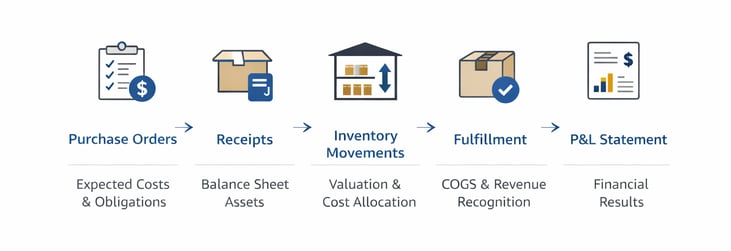
At a high level, the chain looks like this:
- Purchase orders establish expected cost and future obligations
- Receipts convert goods into balance sheet assets
- Inventory movements change valuation and cost allocation
- Fulfillment converts inventory into cost of goods sold
- The P&L aggregates the financial consequences of each event
Each step influences the next. Decisions made early in the chain shape the financial outcomes that eventually appear in the income statement.
1. The purchase order: Where financial reality begins
A purchase order establishes the quantities, expected unit costs, and payment terms for incoming inventory. Teams negotiate pricing, commit to production runs, and define delivery schedules with suppliers. At this stage the business is making commitments that will shape both inventory levels and future cash outflows.
Why it matters financially
The information captured in the purchase order determines the expected value of incoming inventory and establishes the company’s future financial obligations. Unit costs, quantities, and payment terms all contribute to how inventory will eventually be valued and how much capital will be tied up in working inventory.
Downstream impact
Purchase orders rarely stay static. Quantities change, shipments get split, vendors substitute components, and pricing adjustments happen during production. If those changes aren’t tracked consistently across systems, the expected cost basis for inventory starts to drift. That drift carries forward into landed cost calculations and eventually into margin reporting.
2. Receipt and landed cost: Turning goods into financial assets
Inventory arrives at a warehouse, fulfillment center, or production facility. Goods are inspected, counted, and entered into inventory records so they can be stored, assembled, or prepared for distribution.
Why it matters financially
At the moment of receipt, inventory becomes a balance sheet asset. But the unit cost recorded at this point rarely reflects the full cost of the product. Freight, duties, tariffs, insurance, and other fees have to be allocated to determine the true landed cost of each unit.
Downstream impact
Landed cost allocation isn’t always straightforward. Shipments may arrive in stages, invoices may appear weeks later, and freight costs may apply across multiple SKUs. When these costs are tracked manually or applied after the fact, unit costs become distorted. That distortion flows directly into inventory valuation and eventually into COGS calculations.
3. Inventory movements: Operational activity as financial events
Inventory rarely stays in one place. Products move between warehouses, get assembled into finished goods, or are adjusted to reflect damaged or missing stock. Transfers, production runs, and adjustments are routine parts of inventory operations.
Why it matters financially
Every movement changes the value and composition of the inventory asset. Transfers determine where inventory value sits across locations. Assemblies convert raw materials into finished goods with different cost structures. Adjustments change the total value recorded in inventory.
Downstream impact
Without a live inventory ledger connecting operational movements to financial value, discrepancies start to accumulate. Operational quantities may appear correct in warehouse systems while financial records tell a different story. Over time those differences require reconciliation to bring operational and financial records back into alignment.
4. Fulfillment and revenue: When inventory becomes COGS
Orders are fulfilled and products are shipped to customers through ecommerce channels, retail distribution, or wholesale agreements. Inventory leaves the warehouse and enters the customer’s hands.
Why it matters financially
Shipment converts inventory into cost of goods sold and triggers revenue recognition. At this point, the system has to determine the cost basis of the units being sold while also recording the associated revenue.
Downstream impact
If the underlying unit costs are incomplete or inaccurate, the resulting gross margin calculations won’t be reliable either. Discounts, platform fees, and returns add further complexity. Without accurate cost attribution, financial reports stop reflecting the true economics of each product sold.
5. The P&L: The result of dozens of micro events
By the time financial results are reported, inventory has moved through purchasing, receiving, storage, production, and fulfillment. Dozens of operational actions have shaped the final outcome.
Why it matters financially
COGS is the cumulative result of every cost allocation, inventory movement, and fulfillment event that occurred along the chain. Gross margin reflects the combined effects of purchasing discipline, landed cost accuracy, inventory management, and fulfillment execution.
Downstream impact
Errors introduced early in the chain compound as inventory moves through the system. By the time discrepancies appear in the P&L, the original source of the issue may be several operational steps removed. Period-end adjustments and reconciliations often end up correcting upstream inconsistencies rather than providing real financial insight.
A recent episode of the BlueOcean by StartOps podcast previewed the future of inventory management and automation
Fixing the broken chain
The traditional systems that most inventory-driven businesses rely on are inherently vulnerable to “losing the plot”, financially speaking.
Purchasing systems track orders. Warehouse systems track quantities. Accounting systems summarize financial activity. Each system captures a piece of the picture, but none of them reflects the full sequence of operational events that ultimately determines inventory value and cost of goods sold.
That gap creates constant friction. The numbers that matter most are often the hardest to explain. Finance teams spend days reconciling systems just to understand what actually happened. And decisions about pricing, purchasing, and inventory levels end up relying on approximations, not clear data.
A better approach is to design systems around the flow itself. In a well-designed system:
- Purchase orders connect directly to receipts and supplier invoices
- Freight, duties, and other costs are allocated automatically at the SKU level
- Inventory movements update valuation as they happen
- Fulfillment events trigger both revenue recognition and cost of goods sold
Instead of summarizing inventory activity after the fact, the system reflects the financial consequences of each operational event directly.
That’s the idea behind Mandrel.
Inventory accounting doesn’t begin in the general ledger. It begins the moment a purchase order is issued. Mandrel connects purchasing, inventory, fulfillment, and accounting at the SKU level so the financial consequences of operational events are captured automatically from purchase order to P&L.
If you’d like to see how this approach works in practice, you can schedule a demo with one of our inventory management experts.
Related articles
- Spreadsheets, IMS, or ERP? The Architecture Question Most Brands Miss
- SKU-Level Economics: What Your Gross Margin Isn’t Telling You
- Landed Costs: Not Just Another Financial Metric
- Turn POs into Profits: Strategies for Optimizing Purchase Orders
- Navigating The Impact of Tariffs on Margins